Altcoin Season Index Latest Analysis: Is It Currently “Altcoin Season”?
What Is the Altcoin Season Index?
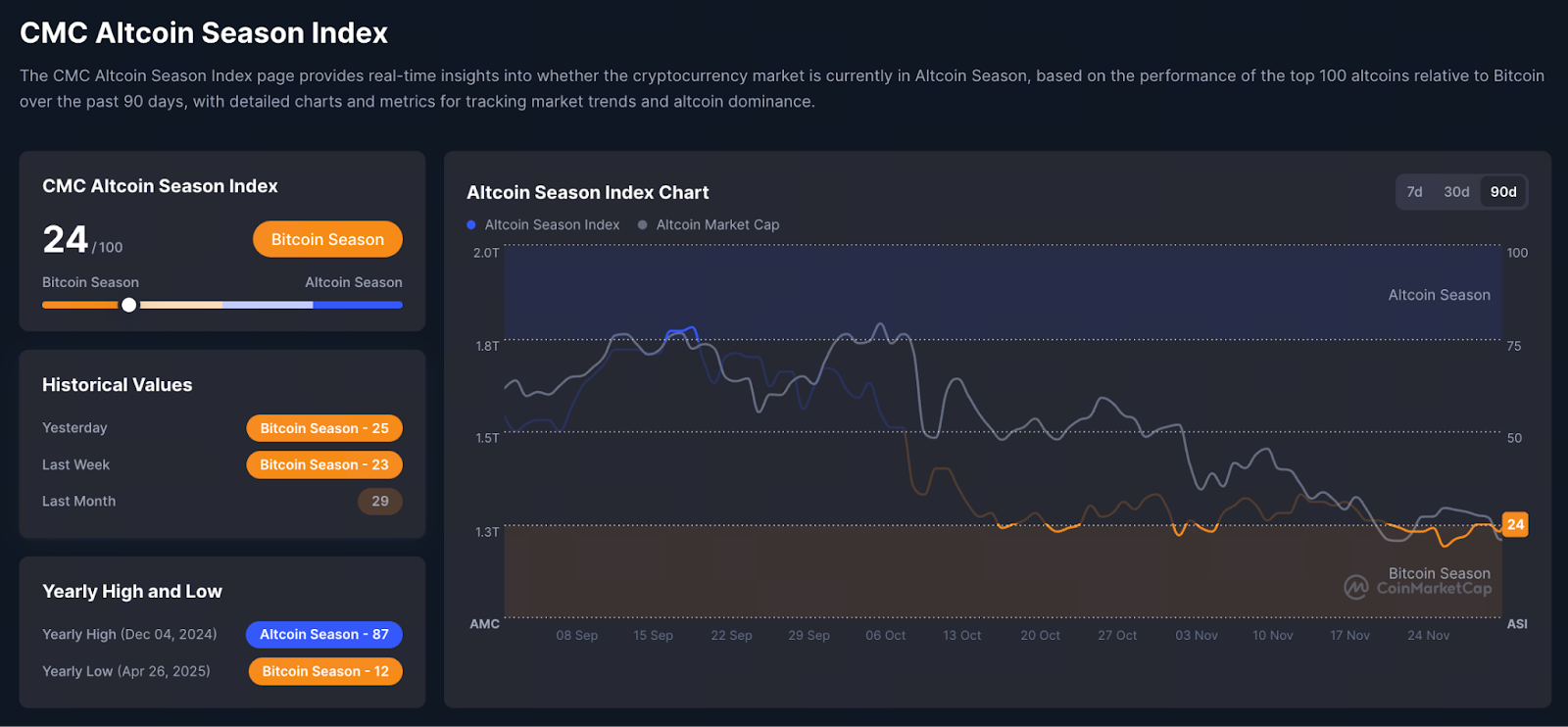
Chart: https://coinmarketcap.com/charts/altcoin-season-index/
The Altcoin Season Index is a key tool for assessing the performance of the altcoin market. It works by comparing whether the top 100 altcoins by market cap—excluding stablecoins and wrapped tokens—have outperformed Bitcoin (BTC) over the past 90 days.
- If the index is above 75, it signals the beginning of an “Altcoin Season.”
- If the index falls below 25, Bitcoin is outperforming altcoins overall, signifying a “Bitcoin Season.”
- An index value between 26 and 74 indicates a transitional or volatile market phase, where altcoins and Bitcoin are performing similarly.
The strength of the Altcoin Season Index lies in its ability to offer a macro-level view of market trends. It helps investors gauge overall capital flows and risk appetite. Investors should use this index as a reference for medium- to long-term strategies, rather than as a signal for short-term trading.
Current Index and Market Overview
As of late 2025, the Altcoin Season Index remains low, hovering between 22 and 26. This suggests the market remains in a Bitcoin-led stable phase, rather than experiencing a broad altcoin rally.
Key market observations:
- Bitcoin continues to attract capital, with large-cap coins showing steady performance and low volatility.
- Some altcoins have seen occasional gains, but overall growth still trails behind Bitcoin.
- Investors favor stable allocations, with long-term capital concentrated in Bitcoin and other large-cap coins.
This environment indicates that the market is still in a Bitcoin-led stable phase, rather than a broad altcoin rally.
Implications of a Low Index: Bitcoin vs. Altcoins
A low Altcoin Season Index highlights several market dynamics:
- Most altcoins are underperforming, limiting short-term returns and increasing the risk of chasing gains.
- Investors prefer stable assets, leaning toward Bitcoin and large-cap coins to mitigate volatility.
- Market sentiment remains cautious; a low index signals reduced risk appetite and wariness toward highly volatile assets.
For investors, this means aggressively increasing altcoin exposure in the short term carries higher risk. Maintaining a diversified portfolio or holding Bitcoin may reduce risk during this period.
How Should Investors Use the Altcoin Season Index?
The Altcoin Season Index is best used for trend analysis and asset allocation decisions:
- Asset allocation: When the index is low, reduce altcoin positions and increase exposure to Bitcoin or other large-cap coins. When the index approaches or exceeds 75, consider moderately increasing altcoin allocations.
- Use with other indicators: Look at the index alongside total market cap, Bitcoin dominance, market sentiment, and macroeconomic factors for a well-rounded investment strategy.
- Long-term positioning: During low-index periods, gradually accumulate promising altcoins to reduce entry costs. When the index is high, evaluate if the market has entered an altcoin cycle and take profits as appropriate.
Combining the Altcoin Season Index with other market data enables more informed investment decisions, allowing for decisions that are not solely based on intuition or short-term market fluctuations.
Risks and Considerations
It is important to note that the Altcoin Season Index is not a flawless tool:
- Sample limitations: It only tracks the top 100 coins, potentially overlooking emerging small-cap altcoins.
- Blind spots for sudden events: Policy changes, macroeconomic shocks, or market panic can disrupt historical patterns.
- Lag effect: The index is based on the past 90 days of data, making it less responsive to short-term market moves.
As a result, investors should avoid relying solely on the index for short-term trading. Instead, combine it with sound risk management and long-term planning.
Looking Ahead: Market Outlook
As the market matures, the Altcoin Season Index may fluctuate. During Bitcoin corrections, capital could flow into promising altcoins and drive the index higher. If the index consistently breaks above 75, it could signal the start of a new altcoin cycle.
Investors should closely monitor the index, while also considering project fundamentals, market sentiment, and macroeconomic factors. Diversification and risk control remain essential. This approach helps maintain a stable long-term strategy, even amid short-term volatility.
Related Articles

The New Era of the NFT Market: From Explosive Peaks to Rational Transformation

The Next 100x Coin? Low-Cap Crypto Gem Analysis

MathWallet Quick Start Guide

Zora NFT Market Update: ZORA Token Airdrop, Layer-2 Expansion, and Creator Incentive Mechanisms

Ethereum Whales Revealed: Who Are the True ETH Giants in 2025?