

Search Token/Wallet
XRP Spot ETFs are investment products that use XRP as the underlying asset and are traded on stock exchanges, allowing investors to gain exposure to XRP's price without directly managing a crypto wallet or private keys. As crypto assets gradually enter traditional financial investment channels, XRP ETFs have become one of the key products connecting institutional capital with the cryptocurrency market.
Since 2026, there has been a notable divergence between the funding performance of XRP ETFs and the price trends of XRP. According to Crypto ETF statistics, as of October 9, 2026, the five XRP spot ETFs tracked had a cumulative net inflow of approximately \$1.81 billion, with a net asset value of about \$1.57 billion. Despite the continuous inflow of funds into these products, the price of XRP has not shown a sustained upward trend that matches the cumulative inflow.
## Key Points
- XRP spot ETFs provide investors with a channel to gain exposure to XRP's price through a securities account, but ETF fund inflows do not necessarily equate to a rise in XRP prices.
- Net inflows into ETFs reflect the net change in fund share subscriptions and redemptions. How funds are transmitted to the spot market depends on the redemption methods, liquidity arrangements, and trading execution mechanisms.
- The price of XRP is determined by the buying and selling forces of the entire market, and new demand from ETFs may be offset by spot sell-offs, derivatives trading, and macro market pressures.
- There may be a time lag between ETF fund flows and XRP prices; daily or short-term data is insufficient to determine long-term trends.
- Investors need to assess XRP market changes comprehensively by considering ETF net inflows, asset management scale, spot trading volume, market liquidity, and derivatives data.
This phenomenon reflects that there is no simple linear relationship between ETF fund flows and the prices of underlying assets. This article will explain how ETF funds influence spot demand, analyze the impact of market selling pressure, liquidity, derivatives trading, and macro environment on XRP prices, and guide investors on how to correctly interpret ETF fund flows.
## What is an XRP Spot ETF? How Does it Affect the XRP Market?
An XRP spot ETF is an exchange-traded product primarily investing in XRP spot assets. Unlike investors directly purchasing XRP on cryptocurrency exchanges, ETF investors buy and sell fund shares through a securities account, while the fund holds and manages the corresponding underlying assets according to product rules. Its market price is usually closely related to changes in XRP's price but may still be affected by fees, trading periods, and market supply and demand.
The significance of XRP ETFs lies in expanding investment channels for XRP. For some traditional financial investors, directly holding crypto assets involves wallet management, private key custody, and on-chain transfers, while ETFs transfer these processes to fund management institutions and their service providers. Institutional investors can also gain exposure to XRP within existing securities trading and asset allocation frameworks.
From a market supply and demand perspective, spot ETFs may create a new source of demand for XRP. When a fund increases its holdings of underlying assets due to net subscriptions, the demand for related assets may be transmitted to the XRP market through dealers, liquidity providers, or execution channels designated by the fund. However, whether this new demand can drive prices up depends on whether other market participants simultaneously increase their selling.
## How is the Inflow of XRP ETF Funds Transformed into Spot Buying?
To understand the fund transmission mechanism of XRP ETFs, it is essential to distinguish between secondary market trading of ETFs and primary market subscriptions and redemptions.
In the secondary market, investors can trade XRP ETF shares like stocks. If one investor purchases existing ETF shares from another, this transaction does not necessarily require the fund to buy more XRP. Only when market demand drives the creation of new fund shares may there be a change in the holdings of the underlying assets.
The primary market for ETFs typically involves Authorized Participants (APs), who help the fund's share supply adapt to market demand through subscription and redemption mechanisms. According to investor education materials from the U.S. SEC, Authorized Participants can create new ETF shares by delivering assets or cash according to fund rules, or they can redeem shares through the opposite process.
For crypto asset spot ETPs, the redemption mechanism mainly involves two methods:
- Cash Creation/Redemption: Authorized Participants deliver cash, and the fund or its designated execution agency acquires the underlying assets according to product arrangements.
- In-Kind Creation/Redemption: Authorized Participants deliver qualifying underlying assets in exchange for fund shares, and upon redemption, they can receive the corresponding assets.
In July 2025, the U.S. SEC approved the use of in-kind creation and redemption mechanisms for crypto asset ETPs, providing a more flexible asset delivery method for related products.
Therefore, even if there is a net inflow into XRP ETFs, it cannot be directly interpreted as the same amount of XRP being immediately purchased on public spot exchanges that day. Assets may be delivered through over-the-counter transactions, inventory adjustments, or other compliant execution methods, with the specific impact depending on the product structure and trading arrangements.
## Why Does XRP ETF Have Continuous Net Inflows While XRP Prices May Not Rise?
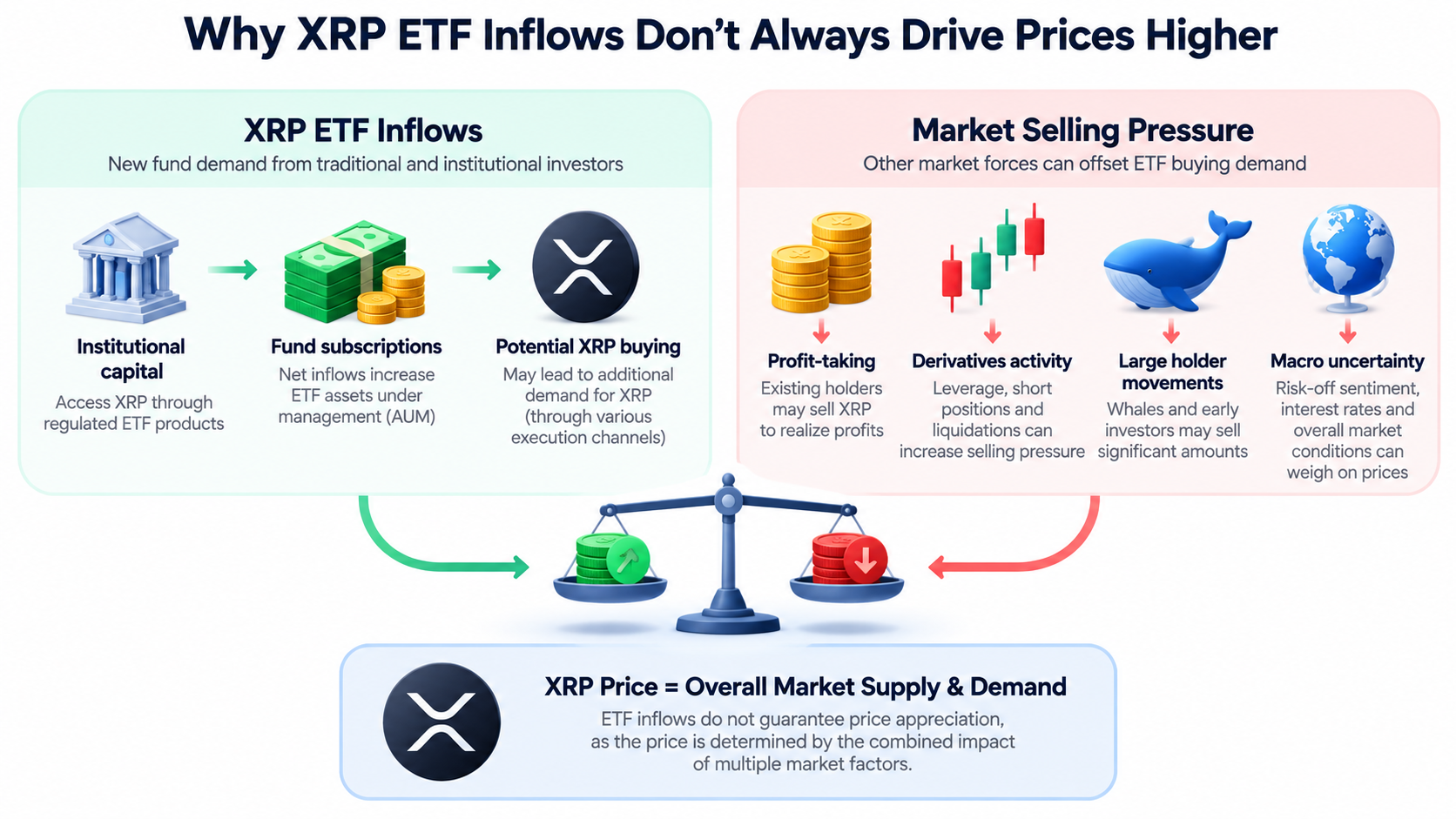
Net inflows into XRP ETFs reflect new demand within a specific investment channel, while XRP's market price is determined by global trading activities. ETF funds are just one part of the overall buying and selling forces in the XRP market.
1. ETF fund inflows may be offset by selling from other market participants. For example, during a certain period, the new demand related to the ETF may reach \$100 million, but at the same time, early holders, short-term traders, and other institutions may also be selling XRP. If the overall market has a strong selling sentiment, the new buying may only absorb the selling pressure and may not be sufficient to drive prices up continuously.
2. ETF fund inflows have a cumulative effect, but prices reflect the continuously changing marginal supply and demand. A cumulative net inflow of \$1.8 billion does not mean that the market suddenly increased purchasing demand by \$1.8 billion on a particular day. These funds may be distributed over several months or even longer, while the price on each trading day is still influenced by the buy and sell orders, market depth, and trading sentiment at that time.
The market performance on October 6, 2026, provides a case in point. According to TokenPost, the total net inflow of U.S. XRP spot ETFs that day was approximately \$3.14 million, yet the price of XRP fell from about \$1.52 to around \$1.46. This indicates that positive ETF fund inflows and short-term price declines can occur simultaneously, but daily data cannot independently prove the specific reasons for the decline.
Additionally, the market may have already priced in positive expectations regarding ETF listings, regulatory progress, or institutional participation. When expectations are already reflected in the price, even if subsequent ETF funds continue to flow in, it may not create new price catalysts.
## Is There a Time Lag Between ETF Fund Inflows and XRP Prices?
There may be a time lag between ETF fund inflows and XRP prices, primarily due to the asynchronous nature of trading execution, data statistics, and market pricing mechanisms.
On one hand, ETF fund flows are usually calculated based on fund share creations and redemptions, changes in holdings, or related reports, while XRP continues to trade in the global cryptocurrency market. When investors see ETF net inflow data for a particular day, the related underlying asset transactions may have already been completed, and the market price may have already reflected this demand.
On the other hand, the demand for ETF-related assets may not all be fulfilled through immediate market orders on a single exchange. Institutions can choose different trading channels based on liquidity and execution costs, making the impact of fund inflows on the public order book more dispersed.
Moreover, price reactions also depend on whether fund inflows are sustainable. Stable net inflows over several weeks may better reflect long-term allocation demand than a large subscription on a single day, but this still does not guarantee price increases. If there is larger selling pressure during the same period, sustained net inflows may coexist with price declines.
Therefore, when researching XRP ETFs, investors should not merely compare a single day's fund inflows with the daily price fluctuations of XRP but should observe the trends in fund flows, price performance, and market structure over a longer time frame.
## Why Can't ETF Fund Inflows Fully Offset Market Selling Pressure?
The selling pressure in the XRP market does not solely come from ETF investors. Individual investors directly holding XRP, institutional trading accounts, liquidity providers, and derivatives market participants can all influence market prices.
Among these, profit-taking in the spot market is a significant factor. When XRP has experienced substantial gains in the past, some holders may choose to sell assets to realize profits. Even if ETFs continue to attract new funds, as long as the scale of market selling exceeds the new buying, prices may still face downward pressure.
The derivatives market can also amplify short-term volatility. Perpetual contracts, futures, and other leveraged instruments allow traders to establish long or short positions. When market prices reach concentrated liquidation zones, passive liquidations may trigger further volatility. Such trading activities can create significant market impacts in a short time, overshadowing the effects of ETF fund inflows.
The macro financial environment is also crucial. As a crypto asset, XRP's price is influenced by overall risk appetite, U.S. dollar liquidity, interest rate expectations, and trends in the crypto market. When investors reduce their exposure to risk assets, even if XRP ETFs still have net inflows, funds withdrawing from other channels may exert pressure on prices.
Thus, while ETF net inflows can serve as an indicator of new investment demand, they should not be viewed as complete data for measuring the net buying power of the entire XRP market.
## How Do the Price Transmission Mechanisms of XRP ETFs Differ from BTC and ETH ETFs?
XRP, BTC, and ETH spot ETFs share similar basic operational logic, providing investors with price exposure to the underlying crypto assets through fund shares and relying on subscription, redemption, and arbitrage mechanisms to maintain the relationship between fund market prices and net asset values.
However, there are differences in the market structures of these three assets.
| Comparison Dimension | XRP ETF | BTC ETF | ETH ETF |
| --- | --- | --- | --- |
| Underlying Asset | XRP | BTC | ETH |
| Main Market Narrative | Cross-border payments, financial infrastructure | Digital scarcity, store of value | Smart contracts, on-chain application ecosystem |
| Supply Characteristics | Fixed initial total supply, with custody release and other supply arrangements | Issuance cap of approximately 21 million | Supply influenced by both issuance and burn mechanisms |
| Price Influencing Factors | ETF demand, holder behavior, payment ecosystem, and market sentiment | ETF demand, macro liquidity, long-term holder supply | ETF demand, network activity, staking, and on-chain ecosystem |
| Impact of ETF Funds | Depends on XRP market depth and supply-demand changes | Depends on BTC market depth and supply-demand changes | Depends on ETH market depth and supply-demand changes |
The investment narrative for BTC revolves more around scarcity and long-term asset allocation, while ETH is closely related to smart contracts, staking, and the on-chain application ecosystem. XRP's market focus also includes payment infrastructure, institutional adoption, and token supply arrangements.
These differences mean that even if all three types of ETFs receive the same scale of net inflows, their price reactions may differ. Especially in cases where market depth, tradable supply, and derivatives position structures vary, the same amount of new demand may have different degrees of price impact.
Therefore, one cannot simply apply the historical relationship between fund inflows and prices of BTC ETFs to predict the market performance of XRP ETFs.
## How Should Investors Correctly Interpret XRP ETF Fund Flows?
For investors focused on the XRP market, ETF fund flows are valuable for reference but should be assessed alongside multiple indicators.
First is the sustainability of ETF net inflows. A large net inflow on a single day may be influenced by specific institutional trades or short-term market events, while continuous fund trends over several weeks are more helpful in observing whether allocation demand is stable. Investors can analyze daily, weekly, and monthly data to distinguish between short-term fluctuations and mid-term fund changes.
Second is the net asset value of the ETF and the number of underlying XRP holdings. The asset management scale of the ETF is influenced not only by fund subscriptions and redemptions but also by changes in XRP market prices. Even without new fund inflows, an increase in XRP prices may raise the fund's net asset value. Therefore, observing the number of XRP held by the ETF can help further differentiate price changes from holding changes.
Third is the trading volume and liquidity in the spot market. If there are continuous net inflows into the ETF while XRP spot trading is active and buying depth improves, it may indicate stronger market demand support. Conversely, if trading volume declines and selling pressure concentrates, even if ETF funds maintain positive inflows, prices may still come under pressure.
Fourth is data from the derivatives market. Open interest, funding rates, and liquidation scales can help investors identify leveraged trading activities. When the market has high leverage, short-term price fluctuations may be more influenced by forced liquidations and position adjustments rather than changes in ETF funds.
Finally, the macro environment and overall market trends should not be overlooked. XRP prices do not operate independently of the crypto market. The trends of BTC and ETH, global risk appetite, and liquidity changes can all affect XRP's trading demand.
Investors can observe fund flows through ETF data platforms like SoSoValue, while cross-analyzing XRP market data, trading volume, and market data provided by trading platforms like Gate. It is important to note that different data platforms may use varying fund coverage and statistical criteria, so consistency in data comparison should be maintained.
## Conclusion
The launch of XRP ETFs has expanded the channels for traditional financial markets to gain exposure to XRP investments and introduced new potential demand to the XRP market. However, continuous inflows into ETFs do not necessarily mean that XRP prices will rise.
Net inflows into ETFs reflect the net changes in fund subscriptions and redemptions, and their impact on the spot market is constrained by trading execution, market depth, and liquidity arrangements. At the same time, XRP prices are influenced by multiple factors, including holders' selling, derivatives trading, macroeconomic conditions, and market expectations.
For investors, understanding how ETF funds transmit to the underlying asset market is more important than simply focusing on net inflow figures. Only by combining changes in ETF holdings, spot trading activities, and the overall market environment can one comprehensively assess XRP's supply-demand structure and potential risks.
## FAQ
### What Does Net Inflow of XRP ETF Funds Mean?
Net inflow of XRP ETF funds typically refers to the amount of funds from new subscriptions exceeding the redemption scale within a specific statistical period. Different data platforms may estimate this based on changes in fund shares, underlying asset holdings, or other disclosed information, so statistical results may vary.
### Does XRP ETF Fund Inflow Mean Institutions Are Buying XRP?
Not necessarily. ETF fund inflows indicate a net subscription demand for the relevant fund shares, but the identities of the investors may not all be institutional. Additionally, ETF subscriptions can be completed through cash or in-kind methods, which does not imply that an equivalent amount of XRP is being immediately purchased on the public spot market.
### Why Does XRP ETF Have Increased Net Inflows While XRP Prices Decline?
Because ETF demand is only part of the market buying power. If spot holders sell, leveraged positions are liquidated, or overall market risk appetite declines, the pressure may outweigh the net inflow, causing XRP prices to drop.
### Can ETF Fund Flows Predict XRP Prices?
ETF fund flows can help observe changes in market demand but cannot independently and reliably predict XRP prices. Investors also need to consider trading volume, liquidity, derivatives positions, macro environment, and market expectations.
### Where Can I View Data on XRP ETF Fund Inflows?
Investors can check XRP ETF fund flows, net asset values, and holding information through platforms like SoSoValue, ETF issuers' official websites, and related fund disclosure documents. When using third-party data, confirm the update dates, product coverage, and calculation methods.
Author: Learn Team
* The information is not intended to be and does not constitute financial advice or any other recommendation of any sort offered or endorsed by Gate Web3.
* This article may not be reproduced, transmitted or copied without referencing Gate Web3. Contravention is an infringement of Copyright Act and may be subject to legal action.
Related Articles

Beginner
Beyond ETFs, who else is redefining the institutional bids landscape in the crypto marketplace for 2026
By 2026, institutional bids in the crypto marketplace extend far beyond ETFs. Digital asset treasury companies, balance sheet asset-liability allocations by publicly listed firms, stablecoin and on-chain return products are together redefining capital structure. This article examines emerging sources of bids outside ETFs and their influence on the marketplace.