

Search Token/Wallet
Understanding Decentralized Autonomous Organizations (DAOs)
2026-11-04 07:59
Blockchain
DAO
DeFi
Ethereum
Web 3.0
Article Rating : 4
152 ratings
The article explores Decentralized Autonomous Organizations (DAOs) as innovative governance structures within the Web3 ecosystem. It highlights how DAOs enable democratic community-driven decision-making by utilizing blockchain technology and smart contracts. Key topics include the operational mechanics of DAOs, benefits and risks associated with their use, and notable DAOs like Uniswap, MakerDAO, and Lido. The article aims to address the importance of decentralization, enhance transparency, and discuss challenges such as security and token concentration while suggesting solutions like soulbound tokens. Ideal for readers interested in crypto governance and decentralization.
# What is a DAO?
Decentralized Autonomous Organizations (DAOs) have emerged as a revolutionary governance structure in the Web3 ecosystem, particularly following significant events in the cryptocurrency market. After the collapse of centralized exchanges in 2022, which triggered major questions about decentralization in the crypto industry, DAOs gained increased attention for their ability to enable community-driven decision-making through transparent voting mechanisms. DAOs collectively hold substantial capital in their treasuries, positioning them as one of the most well-funded sectors in emerging crypto fields like decentralized finance (DeFi). This substantial capital accumulation demonstrates the growing trust and adoption of DAOs as a dominant governance structure in Web3, with some advocates claiming they represent a revolutionary advancement for democracy and could potentially replace traditional business models.
## What is a DAO in Crypto?
A Decentralized Autonomous Organization (DAO) is an innovative online governance structure where no single entity maintains total control over decision-making processes. Understanding what is a DAO requires examining how these organizations operate similarly to peer-to-peer (P2P) networks like Bitcoin, but instead of transferring cryptocurrency, they verify and record digital ballots. Unlike traditional government organizations or corporate boards of directors with hierarchical chains of command, DAOs leverage blockchain technology to provide users with equal access to voting on proposals and maintain a transparent record of all prior decisions.
The theoretical foundation for DAOs was introduced by computer scientist Dan Larimer in the mid-2010s, but they didn't achieve mainstream adoption until Ethereum's launch. Ethereum's "smart contracts" were instrumental in making the world's first DAOs possible. These smart contracts are specialized computer programs that facilitate complex pre-programmed commands, removing intermediaries from decision-making processes and enabling secure voting on digital platforms without requiring centralized ballot verification. Smart contracts on DAOs automatically execute the "will of the community" and record this data on a public ledger, promising a trustless, non-hierarchical voting experience.
The first and most notorious DAO in crypto history was an Ethereum-based project simply called "The DAO," launched in 2016. Traders invested $150 million to participate in this unconventional governance community, which included voting rights on fund distribution from its virtual treasury. However, several months after launch, hackers exploited vulnerabilities in The DAO's smart contract code and stole $50 million worth of crypto funds. This "DAO hack" caused a significant split in the Ethereum development community, with one faction creating a new blockchain to reimburse traders, while others argued that any third-party interference contradicted decentralization principles. Today, Ethereum Classic (ETC) represents the original Ethereum blockchain with the DAO hack in its ledger, while the current Ethereum manually restored the stolen DAO funds.
Despite this high-profile security breach, Web3 developers remained committed to the DAO concept. Hundreds of new crypto projects have adopted DAOs to give users a voice in protocol upgrades. DAOs account for a significant portion of the total value in the DeFi sector, and other projects including play-to-earn games and non-fungible token (NFT) collections utilize DAOs to drive engagement with their online communities.
## How do DAOs Work?
While each DAO has unique operational procedures, most issue cryptocurrencies called "governance tokens," where each token represents one vote on the protocol. To understand what is this governance mechanism, developers encode the rules that community members must follow into smart contracts and deploy them on dedicated "governance portals." When developers or community members propose changes to a decentralized application (dApp) or want to move funds in the DAO's treasury, they write a proposal in the governance portal and submit it for voting. Holders of the dApp's governance tokens stake these cryptocurrencies directly into a smart contract to vote for or against the proposal. Once the scheduled voting window closes, the smart contract automatically tallies the votes and executes the commands corresponding to the winning side.
For example, the ApeCoin DAO, a Web3 community centered around Yuga Labs' popular NFT collection Bored Ape Yacht Club (BAYC), conducted a significant vote in 2022. Community members voted on whether to keep the ApeCoin cryptocurrency (APE) on the Ethereum blockchain or migrate to a competing blockchain like Avalanche. After the voting period concluded, 54% of APE holders voted to remain on Ethereum, so the smart contract did not enact a protocol change, demonstrating the direct democracy enabled by DAO governance structures.
## How to Join a DAO
Joining a DAO involves acquiring the official governance token associated with a Web3 project's protocol. Once you have the associated cryptocurrency in your digital [wallet](https://www.gate.com/web3), you can link your crypto account on the DAO's homepage and participate in voting procedures. For instance, to join the decentralized crypto lending site Aave, you need AAVE tokens to vote on proposals in Aave's Governance Forum. Thanks to the proliferation of DAO projects like Aave and Uniswap, governance tokens are readily available on major crypto exchanges and decentralized trading platforms. Many DAOs also distribute governance tokens as rewards to community members who contribute to their projects, such as early traders or yield farmers.
However, even without governance tokens in your crypto wallet, you can still view upcoming proposals and write comments on some governance forums. Many DAOs feature open-source code to provide complete transparency and welcome improvements and suggestions from the online community. Although governance tokens are required to place votes on proposals, anyone can view and contribute to online debates and discussions, fostering an inclusive environment for community participation.
## What are the Benefits of Crypto DAOs?
The primary advantages of DAOs that excite community members are their inherent decentralization and transparency. When asking what is a DAO's core benefit, the answer lies in how blockchain technology's anonymity and decentralization prevent authorities from blocking anyone's vote on a protocol, ensuring democratic participation. As long as individuals have access to a crypto wallet and the protocol's native governance token, they can express their opinions on significant changes. This open decision-making model stands in direct contrast to hierarchical corporate and government structures, where decision-making processes are often opaque and restricted to select individuals.
DAOs eliminate the possibility of "closed door" meetings and significantly reduce fears of election fraud through the determinacy of smart contract code and the transparency of a blockchain's public ledger. Every vote is recorded immutably, and the execution of decisions is automated and verifiable, creating an unprecedented level of accountability and trust in governance processes. This transparency extends to financial management as well, with DAO treasuries and fund allocations visible to all community members, fostering a sense of collective ownership and responsibility.
## What are the Risks of Crypto DAOs?
Despite significant evolution since the 2016 "DAO hack," cyberattacks remain a substantial concern for DAO developers and voters. Hackers who discover vulnerabilities in a smart contract's source code can steal funds or interfere with elections. The open-source nature of many Web3 programs, while promoting transparency, also provides skilled hackers with a clear window into a DAO's system. If any bugs exist in a DAO's code, malicious actors can exploit the protocol, potentially invalidating the entire Web3 project and causing significant financial losses.
Beyond security concerns, DAOs often struggle with decision-making efficiency and implementation speed. Since DAOs operate on code rather than a top-down command chain, they must use their voting model for every proposal, including minor software upgrades or bug fixes. This overreliance on community polling can stall dApps' innovation and growth compared to centralized competitors, who can make rapid decisions through executive leadership.
Additionally, questions persist about the true democratic nature of some DAOs. Research suggests that less than 1% of DAO community members hold up to 90% of the governance tokens on some Web3 applications. The more tokens one entity controls, the more power they wield over voting procedures, potentially creating oligarchic rather than democratic governance structures. However, some DAO advocates are developing innovative solutions to address this issue. For example, "soulbound tokens" (SBTs) are experimental non-transferrable cryptocurrencies that serve as virtual IDs. Some DAOs might transition to SBTs rather than governance tokens to ensure everyone has an equal say in voting, regardless of their financial resources.
## What's the Most Known DAO in Crypto?
The most prominent DAO varies depending on individual interests and use cases. Some crypto traders may favor DAOs on their preferred decentralized trading platforms, while others may support DAOs involved in charitable causes. Ultimately, each user's favorite DAO will likely relate to shared common interests or services they regularly use in the crypto ecosystem.
While it's impossible to definitively claim any DAO is superior to another, several DAOs command significant market share in Web3. Crypto price aggregator sites feature sections dedicated to the most prominent "DAO tokens," and a few projects consistently rank near the top of the list:
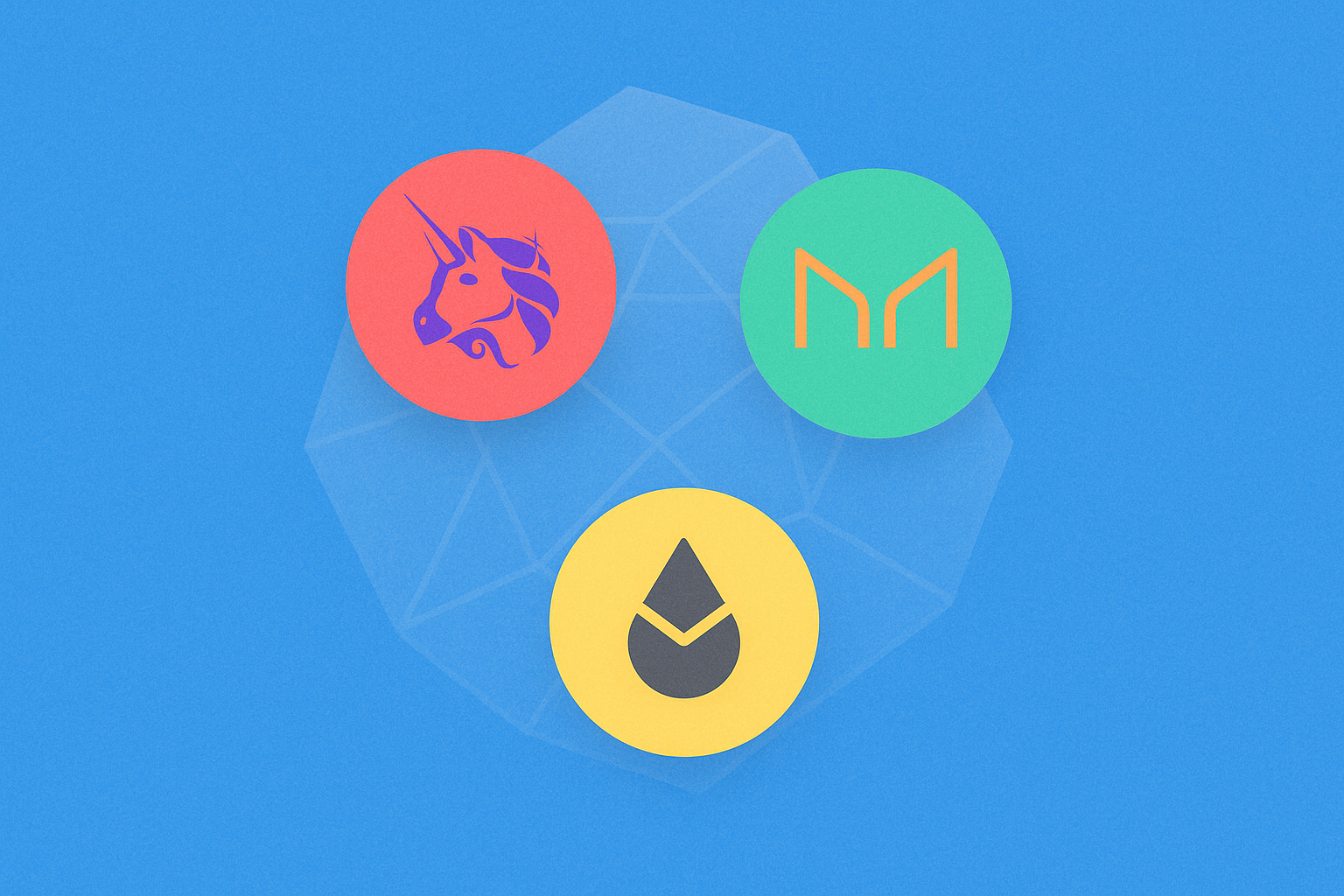
**Uniswap DAO** serves as the governing body for the Ethereum-based decentralized trading platform Uniswap. Uniswap community members vote on proposals using UNI governance tokens on the platform's official Governance tab. Due to Uniswap's major influence in DeFi, UNI tokens are actively traded on numerous trading platforms, making it one of the most accessible and liquid governance tokens.
**MakerDAO**, launched in 2017, operates as a decentralized lending platform on Ethereum best known for launching the stablecoin DAI. Anyone holding MakerDAO's MKR governance token can vote on proposed changes to the protocol, including critical decisions like interest rate adjustments that directly impact the stability and functionality of the DAI stablecoin.
**Lido DAO** is a DeFi platform that helps users stake cryptocurrencies including Ethereum, Solana, and Polygon (MATIC). Individuals interested in voting on changes to Lido's procedures or treasury management utilize the LDO governance token. Lido's importance has grown significantly with Ethereum's transition to proof-of-stake, making it a crucial infrastructure provider in the DeFi ecosystem.
## Conclusion
Decentralized Autonomous Organizations represent a paradigm shift in organizational governance, offering unprecedented transparency, community participation, and democratic decision-making in the Web3 ecosystem. Understanding what is a DAO and what is this revolutionary governance model helps explain their growing importance in the crypto industry. Despite facing significant challenges including security vulnerabilities, decision-making inefficiencies, and concerns about token distribution concentration, DAOs continue to evolve and gain traction across various sectors of the cryptocurrency industry. With substantial capital held in DAO treasuries and representing a significant portion of DeFi's total value, these organizations have demonstrated remarkable resilience and growth potential. As innovative solutions like soulbound tokens emerge to address current limitations, and as more projects adopt DAO governance structures, these organizations may indeed fulfill their promise of revolutionizing democracy and corporate governance in the digital age. The success of prominent DAOs like Uniswap, MakerDAO, and Lido demonstrates that despite early setbacks like the 2016 DAO hack, the fundamental concept of decentralized governance remains compelling and viable for coordinating collective action and managing shared resources in the crypto ecosystem.
## FAQ
### What does "DAO" stand for?
DAO stands for Decentralized Autonomous Organization. It's a blockchain-based entity governed by smart contracts and community members.
### What is DAO?
A DAO is a decentralized organization governed by smart contracts, operated transparently and controlled by members without central authority. It requires rules, funding tokens, and voting rights.
### What is DAO used for?
DAOs are used for decentralized governance, collective decision-making, and fund management in Web3 projects. They enable community-driven operations and transparent voting on proposals.
* The information is not intended to be and does not constitute financial advice or any other recommendation of any sort offered or endorsed by Gate.
Related Articles
Understanding Polygon Blockchain: A Comprehensive Guide
This article explores the Polygon blockchain network, highlighting its significance as a layer-2 scaling solution for Ethereum. It discusses Polygon's technology innovations, including plasma chains, sidechains, and the zkEVM, which improve transaction speed and reduce costs. The guide further explains the role of the MATIC token and its applications across DeFi, NFTs, and gaming sectors. Readers will gain insights into Polygon's contributions to blockchain scalability, security, and decentralized governance, making it a key player in the Web3 ecosystem.
2026-11-04

Understanding the Basics of Smart Contracts
"Understanding the Basics of Smart Contracts" explains the transformative role of smart contracts in blockchain technology. The article covers their definition, unique features such as automatic execution and reduced intermediaries, and origins with Nick Szabo and the Ethereum revolution. It guides readers through the lifecycle, from writing to deployment, and explores applications across DeFi, identity verification, and decentralized trading. Designed for tech enthusiasts and industry professionals, the article enhances understanding by comparing blockchains and smart contracts, providing examples such as Ethereum's ERC-20 standard.
2025-11-30

Layer 2 Scaling Made Easy: Bridging Ethereum to Enhanced Solutions
The article delves into Layer 2 solutions, focusing on optimizing Ethereum's transaction speed and cost efficiency through bridging. It guides users on wallet and asset selection, outlines the bridging process, and highlights potential fees and timelines. The article caters to developers and blockchain enthusiasts, providing troubleshooting advice and security best practices. Keywords like "Layer 2 scaling," "bridge services," and "optimistic rollup technology" enhance content scannability, aiding readers in navigating Ethereum's ecosystem advancements.
2025-12-24
ZK Rollups Explained: Enhancing Blockchain Scalability Through Zero-Knowledge Solutions
This article delves into ZK Rollups, a key layer-2 scaling solution for Ethereum, enhancing blockchain scalability through zero-knowledge proofs. It addresses the challenges of high transaction costs and congestion in Ethereum's main chain, offering faster transactions and lower fees. Targeted at developers and users involved in Web3 and blockchain applications, the article explains the workings, benefits, and distinctions of ZK Rollups compared to optimistic rollups. Structured to provide clear insights on its applications in DeFi, gaming, and NFT trading, it highlights projects like Polygon, StarkWare, and Immutable X, portraying ZK Rollups as a pivotal technology in blockchain scalability.
2025-12-18
Understanding the Functionality of Polygon Sidechain Technology
Explore the significance of Polygon, a pivotal blockchain solution enhancing Ethereum's scalability in the Web3 ecosystem, backed by major brands like Disney and Meta. Learn about its layer-2 sidechain technology, offering reduced transaction fees and improved speeds. Delve into MATIC's role in network security and governance, along with comparisons to Ethereum and other layer-2 solutions. Understand its diverse applications in DeFi, NFT trading, and blockchain gaming. Polygon's ongoing commitment to decentralization and security reforms emphasizes its importance in the blockchain industry's growth.
2025-12-20

How do cryptocurrency competitors compare in market share, performance, and user adoption in 2026?
This comprehensive analysis examines how major cryptocurrency competitors diverge across market share, performance, and user adoption in 2026. Bitcoin maintains dominance above 60% while institutional investors adopt core-satellite portfolios allocating 60-80% to Bitcoin and 15-25% to Ethereum. Layer-2 solutions command a decisive 40% market share advantage over legacy networks, with Solana leading at 1,133 TPS and driving institutional TVL beyond $50 billion. Regional adoption varies dramatically: Asia-Pacific accelerates at 11.6% CAGR driven by digital transformation, while North America concentrates 75% institutional users. Trading activity concentrates on Gate and leading platforms, with top five cryptocurrencies maintaining 61% combined market share. Understanding these divergent trajectories is essential for investors navigating competitive positioning and institutional capital flows.
2026-02-08
Recommended for You

What is BULLA coin: analyzing whitepaper logic, use cases, and team fundamentals in 2026
BULLA coin introduces decentralized accounting and on-chain data management innovation built on BNB Smart Chain, eliminating intermediaries while ensuring real-time transaction verification. The platform addresses critical gaps in cryptocurrency infrastructure by embedding accounting logic directly into smart contracts, enabling transparent audit trails and regulatory compliance. Real-world applications include seamless transaction imports across multiple exchanges, comprehensive crypto portfolio tracking, and secure record-keeping for investors. Trade import tools enhance user experience by automating data categorization and consolidation. Founded in 2021 by blockchain architect Benjamin with support from experienced fintech designers and engineers, BULLA Networks demonstrates active development momentum with continuous smart contract iterations through early 2026. The 2026-2027 strategic roadmap prioritizes network infrastructure expansion and enhanced security protocols, positioning BULLA as a robust decen
2026-02-08

What is on-chain data analysis and how does it reveal whale movements and active addresses in crypto?
On-chain data analysis reveals cryptocurrency market dynamics by examining active addresses and transaction metrics that expose whale movements and investor behavior. This comprehensive guide explores how blockchain data serves as a critical market indicator, demonstrating the correlation between large holder activities and price movements—such as FLOKI's 950% surge in whale transactions. The article covers whale movement tracking, holder distribution patterns showing 73.47% concentration among major stakeholders, and on-chain fee trends as cycle indicators. Essential metrics include active addresses reflecting genuine network participation, transaction volumes revealing strategic positioning, and network congestion patterns during market cycles. By tracking these interconnected indicators through platforms like Glassnode and Gate, investors and traders can identify market sentiment shifts, anticipate price movements, and distinguish institutional activity from retail participation, making on-chain analysis i
2026-02-08

What is Vodra (VDR) crypto: whitepaper logic, use cases, and fundamentals analysis for 2026
Vodra (VDR) is a decentralized blockchain platform revolutionizing creator economics through AI-powered infrastructure and transparent compensation systems. The project addresses the creator economy's core challenge—unfair intermediary-controlled monetization—by enabling direct audience-to-creator transactions without traditional gatekeepers. VDR's whitepaper establishes a dual-layer architecture combining artificial intelligence for content assistance with blockchain verification for security and transparency. The platform's real-world applications extend from content monetization to DeFi ecosystem integration, real-world asset tokenization, and AI-driven automation by 2026. Founded by former Google engineer Yu Hu with backing from prominent investors like Dragonfly and The Spartan Group, Vodra positions itself at the intersection of Web3 infrastructure and creator empowerment. Key acquisition channels include Gate and other decentralized exchanges, with development roadmaps targeting API standardization, en
2026-02-08
How do cryptocurrency competitors compare in market share, performance, and user adoption in 2026?
This comprehensive analysis examines how major cryptocurrency competitors diverge across market share, performance, and user adoption in 2026. Bitcoin maintains dominance above 60% while institutional investors adopt core-satellite portfolios allocating 60-80% to Bitcoin and 15-25% to Ethereum. Layer-2 solutions command a decisive 40% market share advantage over legacy networks, with Solana leading at 1,133 TPS and driving institutional TVL beyond $50 billion. Regional adoption varies dramatically: Asia-Pacific accelerates at 11.6% CAGR driven by digital transformation, while North America concentrates 75% institutional users. Trading activity concentrates on Gate and leading platforms, with top five cryptocurrencies maintaining 61% combined market share. Understanding these divergent trajectories is essential for investors navigating competitive positioning and institutional capital flows.
2026-02-08

What is on-chain data analysis and how does it predict crypto market trends
This comprehensive guide explores on-chain data analysis as a foundational tool for predicting cryptocurrency market trends. The article examines how blockchain metrics—including active addresses, transaction volume, and network health—reveal genuine market sentiment beyond price action alone. Key sections analyze whale movements as reliable leading indicators of market direction, demonstrating how large holder distribution patterns expose institutional positioning before broader price shifts occur. The guide further demonstrates how gas fee trends and network congestion serve as real-time sentiment gauges across different blockchain architectures. By tracking these on-chain indicators on platforms like Gate, traders can identify market opportunities before mainstream recognition. The article emphasizes that while on-chain analysis provides measurable predictive value through transaction flow analysis and holder behavior patterns, it functions best as a complementary tool alongside other market analysis metho
2026-02-08

How Does VeChain (VET) Community and Ecosystem Activity Compare to Other Layer 1 Cryptocurrencies in 2026?
This comprehensive analysis examines VeChain's community and ecosystem activity relative to competing Layer 1 blockchains in 2026. The article evaluates VeChain's multimillion-follower social infrastructure across Discord and Telegram, extensive developer ecosystem featuring 5,000+ DApps, and robust on-chain metrics with 2.5 million daily active addresses. Key findings highlight VeChain's enterprise-grade differentiation through supply chain solutions, institutional partnerships with Fortune 500 organizations, and proven real-world applications. While VeChain demonstrates lower developer numbers than Ethereum and Solana, its focused positioning in enterprise adoption, regulatory compliance through MiCA alignment, and strategic partnerships with DNV and Boston Consulting Group establish competitive advantages in B2B blockchain adoption, positioning VET as a distinctive Layer 1 leader within enterprise-centric ecosystems.
2026-02-08