What Is On-Chain AI Inference? Comparing the Compute Business Models of Orbio, Surplus, and Antseed
On-Chain AI Inference refers to a technical model that combines artificial intelligence model inference with blockchain-based payment, identity, incentive, or verification mechanisms. Unlike running model computations entirely within a blockchain virtual machine, large-scale AI inference in practice is typically still performed by off-chain GPUs, CPUs, or specialized accelerators. The blockchain primarily records transactions, coordinates participants, or provides verifiable economic relationships.
As AI agents, automated trading, and generative AI applications develop, inference is becoming a service that continuously consumes computing resources. Model training is typically periodic, while inference occurs continuously as users submit requests and agents make calls. This is gradually shifting the focus of computing markets from "who owns GPUs" to "who can deliver inference results at stable prices, speeds, and quality."
Orbio, Surplus, and Antseed represent decentralized AI infrastructure approaches worth watching. Starting with the technical principles of AI inference, this article discusses the relationship between computing resource supply, task coordination, and monetization, while comparing the market positioning, potential advantages, and key metrics that require validation for the three projects.
Key Takeaways
-
On-chain AI inference does not mean models must run directly on the blockchain. Most practical solutions use a hybrid architecture of off-chain execution and on-chain payment or verification to avoid blockchain execution costs and throughput limitations.
-
Decentralized AI computing markets aim to connect idle computing resources with AI application demand. Their core challenges include not only whether computing capacity is sufficient, but also task scheduling, service quality, inference latency, and resource utilization.
-
Orbio, Surplus, and Antseed can be compared across different business segments. It is necessary to distinguish between computing resource supply, inference service delivery, and network coordination mechanisms rather than judging their business models based solely on AI or DePIN labels.
-
The commercial value of inference services depends on actual demand. GPU counts, network nodes, and token trading volume do not directly represent real inference revenue. Ongoing paying users and service gross margins better reflect business quality.
-
Decentralized inference still faces technical and economic challenges. Model loading, hardware heterogeneity, result verification, data privacy, and service stability all affect its ability to compete with centralized cloud services.
What Is On-Chain AI Inference, and Why Is It Becoming an Intersection of AI and Web3?
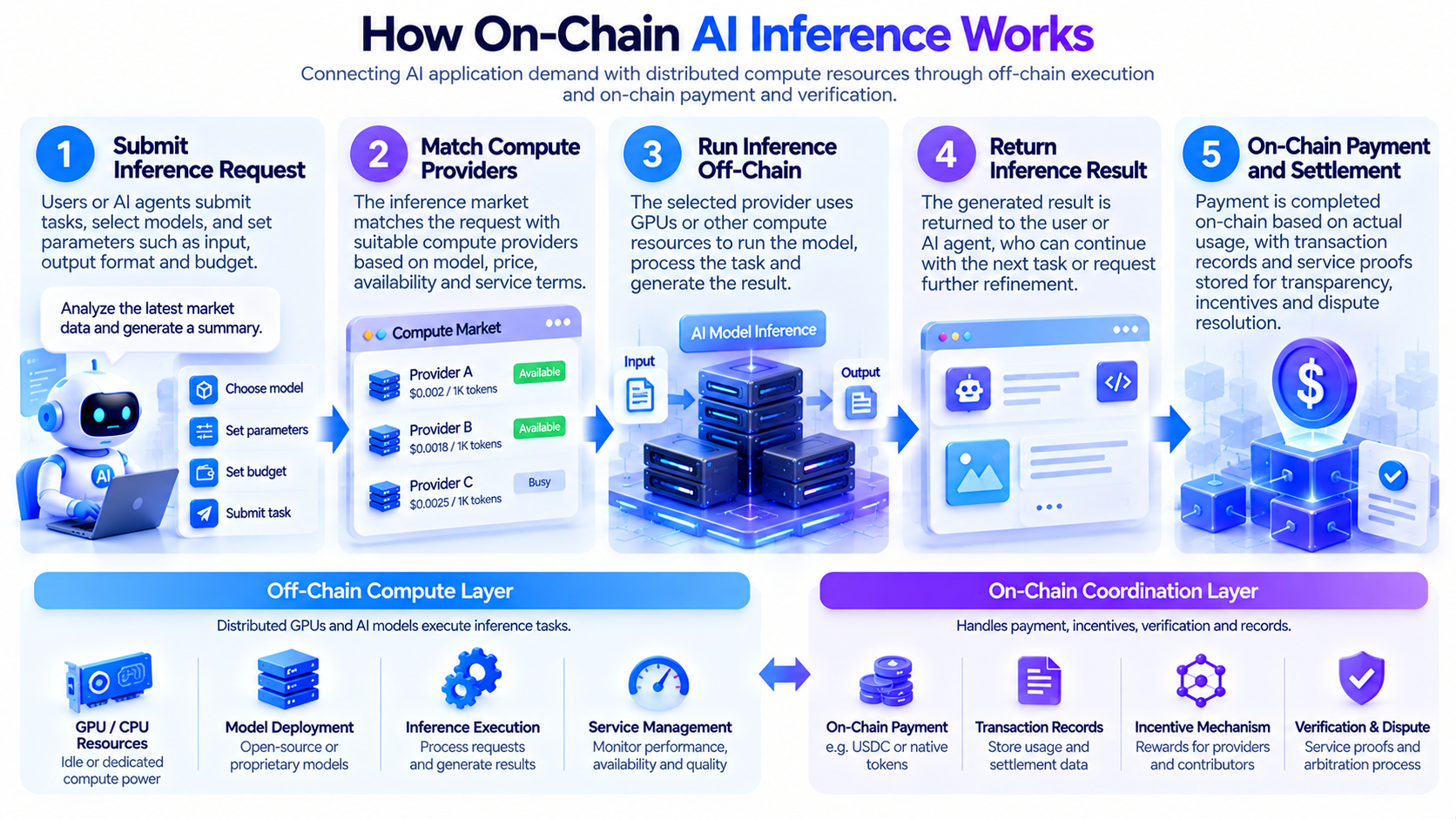
AI inference is the process in which a trained model receives input and generates predictions, text, images, or other results. For example, when a user asks a large language model a question and the model generates an answer; when an AI agent analyzes market data and determines its next action; or when an application calls a model API for content classification, these are all inference scenarios.
Unlike model training, inference demand is typically more distributed, continuous, and frequent. Training may use substantial computing resources during specific periods, while inference costs continue to rise with the number of users, model calls, and context length. For AI agents that need to operate around the clock, inference expenses may even become an important cost affecting their business models.
The on-chain AI inference market seeks to address how inference services are organized and transacted, rather than necessarily moving AI computation itself onto the blockchain. The actual workflow typically includes four stages: the demand side submits a model call request, the market finds a provider capable of delivering the service, an off-chain computing environment performs the inference, and the related payment or settlement mechanism processes the fees.
This structure combines the programmable payment capabilities of blockchain with off-chain AI computation, enabling different participants to establish market relationships around model calls, computing resources, and service pricing.
However, two concepts need to be distinguished here: blockchain-coordinated AI inference and verifiable AI inference. The former emphasizes payments, incentives, and market organization, while the latter emphasizes whether it can be proven that a model performed as required. A platform supporting USDC payments or on-chain credentials does not mean it has achieved cryptographic verification of inference results.
Why Can Decentralized AI Inference Markets Offer Lower-Cost Services?
Traditional AI API services are typically priced directly by model providers or cloud service providers. After users pay a fee, they call models through a unified interface and receive the corresponding inference results. The advantage of this model is stable service and simple integration, but pricing and supply conditions are primarily determined by service providers.
Decentralized AI inference markets, by contrast, seek to introduce more suppliers. Different providers can offer model API quotas, idle GPU resources, or self-deployed inference services and compete for user requests.
Lower prices may primarily come from three mechanisms.
The first is API quota aggregation and resale. The market aggregates model calling capacity from different channels and offers discounts through differences in procurement costs, provider competition, or platform subsidies. Its advantage is that it does not need to build model infrastructure from scratch, but actual costs still depend on upstream services.
The second is idle computing capacity utilization. Individuals or institutions that own GPUs can provide inference capacity during idle periods, improving hardware utilization. However, this model needs to address differences in device performance, model deployment, and service stability.
The third is token incentives and market subsidies. Platforms can reduce the price users pay on the surface through rewards, points, or on-chain credentials to attract early demand. However, if discounts are primarily supported by subsidies rather than improved computing efficiency, the long-term price advantage may be difficult to sustain.
Therefore, determining whether a platform truly reduces inference costs requires more than comparing displayed API prices. It also requires examining subsidy sources, upstream costs, service quality, and sustainability after subsidies decline.
What Is Orbio, and How Does It Enable AI Agents to Purchase Inference Credits Autonomously?
Orbio is positioned as an inference resource marketplace for AI agents. In addition to providing model access points, it seeks to turn inference credits into resources that can be purchased and managed through on-chain assets, allowing agents to allocate inference budgets around their own tasks.
Unlike traditional API subscription models, Orbio introduces CREDIT credentials. Under its design, each CREDIT corresponds to $1 worth of model calling credits within the platform gateway. Users or agents can obtain inference services by purchasing and redeeming CREDIT.
The significance of this model is that it makes inference budgets programmable resources. For example, an AI agent with a wallet and spending permissions can purchase credits based on task requirements, then use model interfaces to complete information analysis, content generation, or other automated tasks.
Orbio also seeks to connect inference services with agent creation, token issuance, and trading functions. Developers can build applications and related assets around agents, creating links between model calls, agent operations, and on-chain trading.
However, this design presents an important question: the issuance and trading of inference credits do not necessarily represent actual inference consumption.
If the market price of CREDIT is lower than its stated calling credit value, users may purchase it because of the discount or hold it for trading or arbitrage expectations. In this case, credential trading activity and actual model call volume may differ significantly.
In addition, if discounts primarily rely on rewards generated by trading fees, they require ongoing trading activity. Once market trading declines, the scale of subsidies and level of discounts may change.
Therefore, when evaluating Orbio, key metrics include CREDIT's actual redemption rate, model call volume, number of repeat users, and whether inference consumption can continue growing without trading incentives.
TechFlow
What Is Surplus Intelligence, and How Does It Reduce AI Calling Costs Through Computing Resource Aggregation?
Surplus Intelligence is closer to an AI inference service aggregation marketplace. It allows different providers to offer model calling interfaces and enables users to obtain inference services from multiple supply sources through independent pricing and request routing.
Unlike Orbio's emphasis on the agent economy and on-chain credentials, Surplus has a relatively direct business logic: it integrates fragmented model services into a unified calling marketplace and improves pricing and service choices through supplier competition.
Providers can offer different model interfaces, and the platform allocates requests to corresponding providers based on routing rules. Users do not need to establish separate calling processes with each model service provider and can instead access services through the aggregated marketplace.
The advantage of this model is that it is easy to understand and more closely resembles traditional API aggregation businesses. The platform's core competitiveness is not how many tokens it issues, but whether it can continuously attract reliable providers, process real calling requests, and maintain low prices and stable response speeds.
Surplus also introduces sensitive information masking, seeking to replace some API keys or other sensitive fields with placeholders before requests are sent to external model service providers. This helps reduce the risk of sensitive information being directly exposed to providers.
However, masking does not mean end-to-end privacy protection. The platform responsible for processing original requests may still access sensitive content, and users need to pay attention to data access permissions, log retention, and the security boundaries of third-party providers.
Another feature of Surplus is that the relationship between product usage and token value is relatively limited. Available public information indicates that the SURPLUS token does not yet directly serve core functions such as inference fee payments, request routing, or marketplace revenue distribution.
This means that even if platform inference requests continue to grow, it cannot be directly inferred that token demand will increase in parallel. Platform business revenue and token value capture are two issues that need to be validated separately.
TechFlow
What Is Antseed, and How Does an Open P2P Computing Network Operate?
Antseed uses an architecture different from Orbio and Surplus. It places greater emphasis on an open peer-to-peer (P2P) computing resource discovery network, allowing demand-side users to directly find available inference service providers rather than relying entirely on a unified gateway for request allocation.
Under this model, computing resource providers can join the network independently and publish the model services they can offer, while demand-side users select providers based on model type, price, and other conditions. The platform primarily handles service discovery and network coordination.
A potential advantage of this architecture is that it reduces dependence on a single gateway and allows computing resource providers of different sizes and types to compete. For developers with specialized model requirements, an open network may also provide more supply options.
However, a P2P architecture introduces additional service quality challenges. Hardware performance, network latency, and operational stability can vary significantly among providers. Even if a supplier claims to provide a certain model, it is still necessary to consider how to verify that the model actually being run is consistent with the model advertised.
Therefore, Antseed's design also involves reputation and staking mechanisms. Its ANTS token is planned for marketplace reputation and participant incentives. Service providers can participate in the related reputation system through staking and seek eligibility for rewards.
Unlike Orbio, which relies on trading fee rewards, Antseed's currently public reward design primarily relies on project treasury funds rather than direct distribution from inference transaction revenue. This means there may still be a gap between reward distribution and actual business revenue.
As of late October 2026, ANTS has not been publicly traded, and the long-term sustainability of its token mechanisms still requires further validation.
TechFlow
How Do the Computing Business Models of Orbio, Surplus, and Antseed Differ?
Although all three projects seek to reduce the cost of accessing AI inference, they are actually addressing different problems.
Orbio focuses on how AI agents can purchase and manage inference resources; Surplus focuses on price competition and request allocation among different model service providers; and Antseed seeks to connect computing resource supply and demand through an open network.
| Comparison Dimension | Orbio | Surplus Intelligence | Antseed |
|---|---|---|---|
| Core Positioning | AI agent inference resource marketplace | AI API aggregation marketplace | Open P2P inference network |
| Primary Users | AI agents and developers | API users, developers, and agents | Computing resource demand-side users and providers |
| Resource Access Method | Purchase and redeem CREDIT | Aggregate providers and route requests | Discover and select independent providers |
| Main Competitive Advantage | Programmable procurement of inference credits | Price competition and a unified interface | Open supply and flexible selection |
| Related Tokens | ORBIO, CREDIT | SURPLUS | ANTS |
| Token Economics Features | Trading fees support CREDIT rewards | No clear service revenue distribution mechanism yet | Staking-based reputation and treasury rewards |
| Key Challenges | Whether credential trading can translate into real consumption | Whether platform growth can create token value capture | P2P service quality and incentive sustainability |
From a business model perspective, the three projects can also be further categorized by their revenue and incentive structures.
Orbio is closer to a combination of inference credits and an agent asset economy. It seeks to connect inference consumption and on-chain assets through CREDIT, but it needs to demonstrate that actual consumption can support marketplace operations rather than relying primarily on trading activity.
Surplus is closer to a traditional API aggregation service. Its core business opportunity lies in aggregating supply, processing calling requests, and providing value-added features, but actual platform revenue, profit margins, and their relationship with the token still need to be assessed independently.
Antseed is closer to an open computing service discovery network. It seeks to coordinate supply and demand through reputation and staking mechanisms, but it needs to validate provider quality, actual transaction scale, and whether stable revenue sources can be formed beyond treasury incentives.
Therefore, competition among the three is not simply about who offers the lowest inference price, but about who can establish a more stable supply network, attract ongoing paying users, and create an economic structure capable of covering operating costs.
How Can You Determine Whether a Decentralized AI Inference Project Has Real Demand?
AI inference projects often showcase the number of models, supported providers, inference requests, or token trading activity, but these metrics cannot be directly equated with actual business revenue.
-
Focus on actual paid call volume. A platform processing a large number of requests does not mean that all requests come from independent paying users. Test requests, incentive-driven calls, or low-cost automated traffic may all inflate usage data.
-
Observe user retention and repeat spending. If developers use a platform only because of early subsidies and switch to other services once discounts disappear, current usage may not be sustainable. In contrast, continuously operating AI agents, applications that consistently call APIs, and developers willing to pay market prices are stronger indicators of actual product demand.
-
Analyze the actual cost of inference services. Lower displayed prices may result from upstream procurement advantages or token subsidies. Only after considering computing costs, bandwidth, routing, payment, and operations and maintenance expenses can a platform's sustainable profitability be assessed.
-
Distinguish between platform revenue and token value. A platform may have many users, while its token does not participate in payments, staking, or revenue distribution. Conversely, active token trading does not mean that inference services have gained market acceptance.
-
Pay attention to service quality. Inference latency, request success rates, model consistency, and data security are all important factors for developers choosing infrastructure. If a platform cannot provide stable services, it may be difficult to enter production environments even at lower prices.
Together, these metrics form a basic framework for evaluating decentralized AI inference markets. Compared with a single measure such as trading volume or token price, sustained paid demand and actual service delivery capabilities deserve greater attention.
What Risks Do Decentralized AI Inference Markets Face?
The main challenge of decentralized AI inference is not simply whether it can find low-cost GPUs, but whether it can deliver model services in a stable, verifiable, and secure manner.
At the technical level, performance differences may exist among hardware and service providers. Model loading times, response latency, concurrency capacity, and fault recovery mechanisms all affect the application experience. For AI agents that need to execute tasks continuously, a single inference failure may interrupt the entire workflow.
At the security level, model requests may contain user data, business information, or even sensitive credentials. Even if a platform uses masking, trusted execution environments, or other protective measures, it still needs to clearly define which participants can access original inputs and whether data is recorded or retained.
At the economic level, token rewards may help a marketplace obtain early liquidity, but they may also obscure actual supply and demand. If rewards primarily rely on treasury funds or trading activity, projects need to explain how service pricing and provider revenue will be maintained after subsidies decline.
At the market level, decentralized platforms must also compete with established cloud services and AI API providers. Centralized services typically offer uniform service standards, mature developer tools, and more comprehensive customer support. Decentralized markets need to demonstrate why users should change their existing procurement methods through pricing, openness, composability, or advantages in specific scenarios.
Therefore, decentralization does not inherently mean lower costs, better privacy, or more reliable services. Different architectures involve trade-offs, and users should choose appropriate inference services based on their actual needs.
Summary
On-chain AI inference markets are seeking to reorganize supply and demand for model calls and computing resources. Their core value does not necessarily come from placing AI computation on the blockchain, but from enabling more participants to provide and access inference services through on-chain payments, marketplace coordination, credentials, and incentive mechanisms.
Orbio, Surplus Intelligence, and Antseed demonstrate three different development paths: Orbio emphasizes autonomous purchasing of inference credits by AI agents, Surplus connects supply and demand through API aggregation and price competition, and Antseed seeks to establish an open P2P computing resource discovery network.
Each model has its own advantages and issues that require validation. Orbio needs to demonstrate real consumption demand for CREDIT, Surplus needs to establish a clear economic relationship between platform operations and its token, and Antseed needs to address service quality and incentive sustainability.
For the sector as a whole, the key to future competition may no longer be simply offering the lowest inference quote, but whether a project can establish stable service delivery capabilities, sustained paid demand, and a business model that does not depend on short-term subsidies.
FAQ
What does on-chain AI inference mean?
On-chain AI inference generally refers to combining AI model inference with blockchain-based payments, incentives, identity, or verification mechanisms. Most actual model computation is still completed off-chain.
What is the difference between on-chain AI inference and decentralized GPU computing capacity?
Decentralized GPU computing capacity emphasizes the supply and leasing of computing resources, while on-chain AI inference markets focus more on model calls, request routing, fee settlement, and service delivery. The two may overlap, but they are not exactly the same.
What is CREDIT used for on Orbio?
CREDIT is designed as an inference credit credential within the Orbio platform. Each unit corresponds to a stated value of $1 in model calling credits and can be used to redeem related services.
What is the main advantage of Surplus Intelligence?
By aggregating different model service providers, allowing independent pricing, and allocating inference requests, Surplus provides developers with more pricing and service options.
Why does Antseed use a P2P architecture?
Antseed seeks to allow demand-side users to directly discover and select independent computing resource providers, reducing reliance on a unified gateway while coordinating marketplace participants through reputation mechanisms.
Is decentralized AI inference always cheaper than traditional APIs?
Not necessarily. Some platforms may offer lower prices because of market competition, while others may rely on token rewards or temporary subsidies. Actual costs also depend on the model, service quality, and call volume.
Will growth in AI inference platform usage drive token prices higher?
There is no necessary relationship. It is first necessary to confirm whether the token serves actual payment, staking, or other economic functions, and whether platform growth can translate into corresponding token demand.
How can you determine whether an AI inference project has long-term value?
Key factors to consider include actual paid call volume, repeat usage rates, service stability, inference costs, provider revenue, and business performance after token incentives decline.
Related Articles

What Is ERC-8183? Exploring the AI Agent Commercial Standard and the Infrastructure of the Decentralized Agent Economy

AI Agents Becoming Economic Actors: What Infrastructure Gaps Can Blockchain Fill?

What Is RoboForce? An In-Depth Analysis of the Technical Path and Industrial Prospects of an AI Robotic Workforce Platform
Anthropic vs. OpenAI: Revenue, Compute Capacity, and Business Models Compared
Talus Network: Building a Decentralized Layer 1 Ecosystem for AI Agents