

Search Token/Wallet
Why Is MSCI Excluding Digital Asset Treasury Companies? How DAT Strategies Affect Stock Valuations and Capital Markets
On November 11, 2026, MSCI announced the results of its quarterly index review, confirming that companies including [Strategy](https://www.gate.com/learn/articles/global-cryptocurrency-concept-stocks-overview/5976) and Metaplanet would be removed from the relevant indexes. The changes will be implemented after the market close on November 30 and will take effect on December 1. Unlike the previous discussion focused on the proportion of digital asset holdings, MSCI has adopted a broader framework for identifying non-operating companies. The framework focuses on whether a company has substantial operating activities rather than simply holding and managing investment assets.
The impact of this change extends beyond index constituent adjustments. For digital asset treasury (DAT) companies that rely on capital market financing to purchase crypto assets, index eligibility may affect passive fund holdings, stock liquidity, market valuations, and future financing costs. If a stock’s premium declines, the company’s ability to purchase more BTC through stock issuance may also be limited. This article analyzes how index removals may affect the capital structures of digital asset treasury companies, and whether the impact could further spread to the crypto market, based on MSCI index rules, the DAT business model, passive fund flows, and the mNAV valuation mechanism.
## Key Takeaways
- MSCI confirmed in its November 2026 index review that it would remove certain companies meeting the criteria for non-operating companies. The changes will be implemented after the market close on November 30.
- The new rules no longer use a uniform threshold of 50% of total assets in digital assets for removal. Instead, they assess the nature of a company by considering operating assets and multiple financial metrics.
- Strategy, Metaplanet, and Yellow Cake were included in the deletion list for the MSCI ACWI IMI. Yellow Cake is a uranium investment company, not a digital asset treasury company.
- Index removal may prompt funds tracking the relevant indexes to adjust their holdings, but it does not mean that companies must sell their BTC or other digital assets.
- DAT stock valuations depend not only on the market value of held assets, but also on equity financing capacity, capital structure, market premiums, and investor expectations.
- When a stock’s premium to net assets narrows, the economic appeal of raising funds through additional stock issuance to acquire digital assets may decline for DAT companies.
- MSCI’s changes may weaken passive fund support for some companies, but they do not mean that all DAT companies will be removed or that BTC will necessarily decline.
## Why Has MSCI Started Reassessing Digital Asset Treasury Companies?
MSCI is a major global equity index provider. Its indexes are widely used by asset managers, pension funds, ETFs, and other investors for performance benchmarking and portfolio construction. Whether a stock qualifies for inclusion in a relevant index typically depends on factors such as company size, free-float market capitalization, liquidity, and other eligibility requirements. For funds that passively track an index, changes in constituents directly affect portfolio allocations. Index rules therefore have implications beyond statistical classification and may also change the funding structure of listed companies.
The rise of digital asset treasury companies has created new classification challenges for traditional equity indexes. Although some listed companies retain software, financial services, or other operating businesses, their digital asset holdings have grown far beyond their traditional operating assets. Their share prices may be influenced more by changes in BTC or ETH prices than by product sales, service revenue, or operating profits. In such cases, index providers need to determine whether a company is a listed company with independent operating activities or is more similar to an investment vehicle that holds investment assets through an equity structure.
In October 2025, MSCI proposed excluding treasury companies whose digital assets accounted for 50% or more of total assets. The proposal prompted market discussion because a high proportion of asset holdings does not necessarily mean that a company lacks genuine operating activities. In January 2026, MSCI decided not to implement the uniform removal proposal for the time being and instead began studying broader criteria for identifying non-operating companies.
On October 15, 2026, MSCI formally adopted a new screening methodology for non-operating companies and applied it for the first time in its November index review. The new framework is no longer limited to digital assets. It covers different types of companies that may have characteristics of investment vehicles. This means that DAT companies face a broader issue concerning how equity indexes distinguish operating companies from asset investment vehicles, rather than a special restriction targeting crypto assets alone.
## How Does MSCI Determine Whether a DAT Company Is a Non-Operating Company?
MSCI’s new rules use a tiered screening mechanism. First, the company is assessed to determine whether it has sufficient operating assets and therefore substantial business activities. Companies that fail the initial screening are then evaluated using five financial ratios that do not depend on a specific industry classification. If a company triggers exclusion conditions for at least four of the five indicators, it may be classified as a non-operating company that is ineligible for index inclusion.
These indicators concern the relationship between a company’s operating activities and its asset investments, including operating expenses, cash flow, changes in the fair value of assets, and reliance on external financing. The primary objective is to determine whether a company’s economic activities mainly derive from providing products and services to customers or from holding, managing, and financing the purchase of investment assets. For digital asset treasury companies, retaining a small amount of traditional business activity may not be enough to demonstrate that their primary economic activities remain operating in nature.
MSCI has also established a buffer mechanism to prevent companies from frequently entering and exiting indexes due to fluctuations in a single reporting period. For companies already included in an index, the general principle is that they must fail the screening in both of the two most recent annual reporting periods before being deleted. For companies not yet included in an index, triggering the relevant exclusion conditions in either of the two most recent annual reporting periods may prevent them from obtaining initial inclusion. MSCI may also refer to the latest interim financial reports when appropriate.
This framework differs significantly from the previous restriction based on the proportion of digital asset holdings. Holding a large amount of BTC does not automatically mean that a company will be excluded. Operating assets and financial structure are also important. Conversely, even a company that does not hold crypto assets may be subject to the same framework if its primary activities are closer to asset investment than actual operations.
## Which Companies Are Affected by This MSCI Index Adjustment?
The November 2026 index review confirmed that Strategy, Metaplanet, and Yellow Cake would be removed from the relevant constituents of the MSCI ACWI IMI. These three companies have different asset allocation models, but all involve classification questions concerning the relationship between asset holdings and traditional operating activities. The review materials published by MSCI clearly state that these are the three deletion results arising from the first application of the new non-operating company methodology.
MSCI
| Company | Main Asset or Business Characteristics | Significance of This Adjustment |
| --- | --- | --- |
| Strategy (MSTR) | Software business and a large-scale BTC treasury strategy | Loss of eligibility for the relevant indexes may affect passive fund demand |
| Metaplanet | BTC reserves and financing-supported accumulation as key strategies | Faces adjustments to relevant index holdings and a potential valuation reassessment |
| Yellow Cake | Physical uranium investment as its core business | Shows that the new rules do not target digital assets alone |
Strategy is a representative company in the DAT model. The company originally focused primarily on business intelligence software, then gradually expanded its BTC holdings and used equity and debt financing to support digital asset accumulation. Its stock price reflects not only the value of its software business but also BTC market prices, financing expectations, and capital structure.
Metaplanet is a Bitcoin treasury company that has attracted attention in the Japanese market. It increases its BTC reserves through corporate asset allocation and financing activities. Its stock valuation must likewise be analyzed in relation to its holdings, asset value per share, and financing conditions.
It is important to note that Yellow Cake is not a crypto asset company. It is a company focused on uranium asset investments. Its inclusion in the same group of adjustment results further shows that MSCI’s new framework focuses on the nature of a company’s economic activities rather than the specific assets it holds.
In addition, not all digital asset treasury companies were removed in this review. Some companies may still meet the index requirements or may not yet have met the conditions triggering deletion. Companies differ in their operating structures, financial data, and index eligibility. This adjustment should not be interpreted as meaning that all DAT stocks have simultaneously lost index eligibility.
## Why Could Removal by MSCI Trigger Passive Fund Selling?
Equity indexes are used not only to measure market performance but also as the basis for constructing positions in many passive investment products. When a company is included in an index, funds tracking that index generally need to allocate to its stock according to the prescribed weight. When the company is deleted, the funds also need to adjust their portfolios and reduce or eliminate the relevant position. For listed companies that rely on index-based funding support, this change may directly affect buying and selling demand for their stocks.
Suppose an ETF manages \$10 billion in assets and a stock previously had a 0.5% index weight. The fund would theoretically need to allocate approximately \$50 million to that stock. If the company is deleted, the fund would need to adjust this position according to the product rules and reallocate the funds to other constituents. Actual trading is also affected by the fund’s replication method, cash management, use of derivatives, and rebalancing arrangements. Therefore, not all adjustments will be completed at the same time.
The potential size of the outflow from Strategy has attracted particular attention. JPMorgan previously estimated that if Strategy were removed from relevant MSCI indexes, it could trigger approximately \$2.8 billion in stock selling demand. If other major index providers adopted similar measures, the potential impact could increase to approximately \$8.8 billion. These figures are estimates based on specific holdings and index scenarios, not actual outflows that have already occurred.
The impact of passive selling cannot be equated simply with the dollar amount sold. Stock prices are determined by marginal buy and sell orders. Even if a stock has a high average daily trading volume, concentrated selling may affect quoted prices during specific periods. Conversely, if other investors are willing to absorb the selling or the market has already priced in expectations of the index adjustment, the actual price impact may be smaller than estimated.
In addition to one-time trading during an index adjustment, changes in long-term allocation demand are also important. After exiting an index, relevant funds will no longer need to purchase the stock according to its previous weight even if they receive new subscriptions in the future. A company may lose part of its relatively stable source of passive funding, but actively managed funds, individual investors, and other institutions can still continue to hold or purchase the stock based on their own assessments.
## What Is mNAV for DAT Stocks, and Why Does It Affect Company Valuations?
Digital asset treasury companies differ from conventional operating companies in certain respects. Traditional companies are generally valued based on revenue, profits, cash flow, and growth expectations. DAT companies also require consideration of the value of digital assets on their balance sheets. The market often uses mNAV (Market-to-Net Asset Value) to measure the relationship between a stock’s market capitalization and the company’s net asset value, and to assess how much premium investors are willing to pay for its digital assets and related operating and financing capabilities.
For a company whose primary reserve asset is BTC, analysts can first calculate the market value of its BTC holdings, then account for cash, other assets, liabilities, and the relevant capital structure to determine net asset value on an appropriate basis. The corresponding equity market value can then be compared with the net asset value. Different data platforms may use different methodologies to calculate mNAV, including whether to include the value of traditional businesses, how to treat preferred stock, and whether to use basic or fully diluted shares. As a result, figures from different sources may not be directly comparable.
When mNAV is above 1, the stock’s market value is higher than the corresponding net asset value. Investors may pay a premium because they are optimistic about the company’s ability to increase its digital asset holdings per share through future financing. The premium may also reflect stock liquidity, leveraged exposure, the management team, or the value of other businesses. A premium does not necessarily mean that the stock is overvalued, but it must be supported by a sufficient economic foundation.
When mNAV is below 1, the stock is trading at a discount to the corresponding net asset value. The discount may reflect concerns about liabilities, financing costs, asset volatility, governance risks, and future dilution. For companies that rely heavily on issuing stock to purchase BTC, a discount may also weaken the appeal of continuing to expand through financing.
It is important to note that mNAV is not the only metric for evaluating DAT stocks. If a company also has a software business, cash-generating operations, or a complex preferred stock structure, simply comparing common stock market capitalization with the value of BTC holdings may overlook important asset and liability relationships. Investors need to consider financial statements and capital structure to assess the stock’s economic value more accurately.
## Why Could MSCI Removal Weaken DAT Companies’ Ability to Raise Funds and Accumulate Assets?
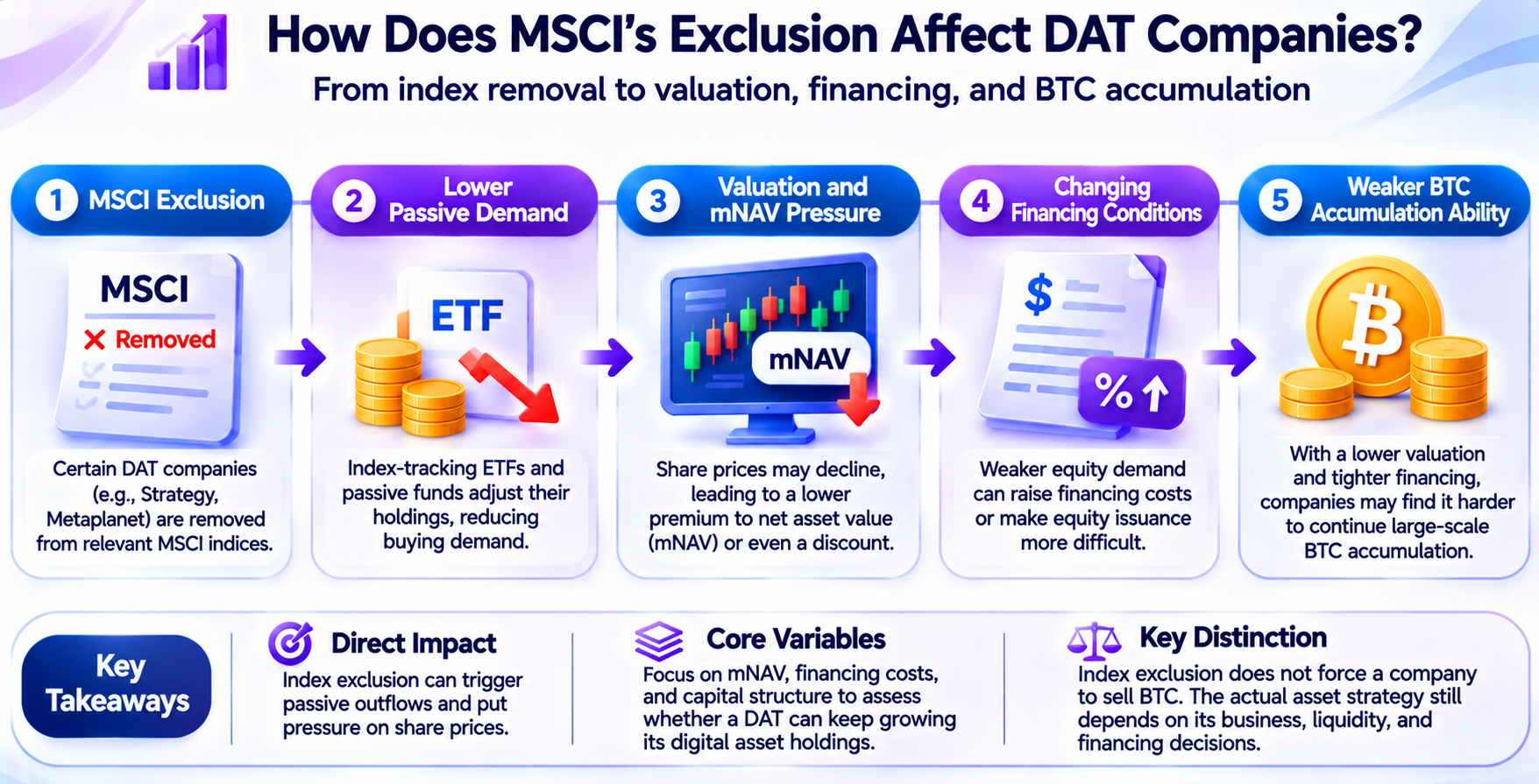
Some DAT companies rely on capital market financing for expansion. They raise funds by issuing common stock, preferred stock, or convertible bonds, and then use the proceeds to purchase BTC, ETH, and other digital assets. As their holdings increase, these companies can present the market with larger digital asset reserves and attempt to continue raising funds through the capital markets. The sustainability of this model is closely tied to stock valuation, financing costs, and investor demand.
When a stock trades at a high premium, a company may be able to raise a large amount of capital by issuing a relatively small number of new shares. If the proceeds are used to purchase digital assets and the value of the newly acquired assets provides a sufficient advantage relative to the newly issued shares, the net assets attributable to each existing share may increase. This is why some DAT companies emphasize growth in BTC holdings per share rather than focusing only on the total number of BTC held by the company.
Suppose a company holds 100 BTC and has 100 common shares outstanding. Ignoring other assets and liabilities, each share represents 1 BTC. If the company can issue 10 new shares at a relatively high price and use the proceeds to purchase 20 BTC, its holdings will increase to 120 BTC, and each share will represent approximately 1.09 BTC. Although the total number of shares increases, the assets attributable to each share also increase. This example shows how premium financing may increase assets per share. It does not mean that an actual company can always raise funds on the same terms.
The situation changes if the stock’s premium disappears. To raise the same amount of capital, the company may need to issue more shares. If the issuance price is below the corresponding net asset value, the offering may also dilute the net assets attributable to existing shareholders on a per-share basis. If investors expect future financing to cause continued dilution, they may further reduce the stock’s valuation, creating a cycle that makes financing more difficult.
MSCI index removal may indirectly affect this mechanism by reducing passive fund demand. The transmission mechanism is not that the index provider directly restricts the company from purchasing BTC. Rather, changes in stock demand may affect its market price and financing conditions. If a DAT stock lacks a premium for an extended period, the company’s ability to expand its digital asset reserves through common stock issuance may be constrained.
However, DAT companies are not limited to common stock financing. Some can also use preferred stock, debt financing, or operating cash flow to support asset allocation. Different financing instruments involve different costs and risks. Debt and preferred stock may also create fixed payment obligations or more complex capital structures. Financing capacity must therefore be evaluated together with the balance sheet, cash reserves, debt maturities, and future repayment arrangements.
## Will Index Removal Force Companies Such as Strategy to Sell BTC?
There is no direct or necessary connection between MSCI index removal and a company’s sale of digital assets. An index adjustment affects whether a stock meets the inclusion criteria for a particular index and how funds tracking the index allocate to that stock. The BTC held by the company remains an asset on its balance sheet. Unless the company decides to sell it for its own operating, financing, or debt repayment needs, the index deletion itself will not automatically trigger the disposal of on-chain assets.
For example, if a passive fund sells MSTR because Strategy exits a relevant index, the transaction takes place in the secondary stock market. The stock is transferred from the fund to other investors, but this does not directly change the amount of BTC held by Strategy. Only if the index removal further affects the company’s financing, liquidity, or debt repayment capacity could it indirectly affect its digital asset allocation through corporate financial decisions.
This indirect impact depends on the company’s capital structure. If the company has sufficient cash reserves and no significant short-term debt repayment pressure, a decline in its stock price may not require it to sell BTC. If the company relies heavily on financing or has short-term debt repayment needs or other cash payment obligations, continued difficulty in raising funds may increase pressure to adjust its asset allocation.
A decline in the stock price must also be distinguished from actual default risk. A decrease in common stock market capitalization does not necessarily cause an immediate cash flow shortfall. Determining whether a company faces pressure to sell assets requires an examination of specific debt terms, collateral requirements, maturity dates, and cash reserves. It cannot be determined solely from changes in the stock price or mNAV.
For the BTC market, the more direct potential impact of index removal may be a reduction in future incremental buying demand rather than the immediate sale of existing holdings. If some DAT companies slow the pace of financing and accumulation, the market may lose part of the institutional buying demand that had been expected. The actual impact will also depend on changes in demand from spot ETFs, other companies, individual investors, and global markets.
## Why Could the DAT Model Create Two-Way Feedback Between Stock Prices and Crypto Asset Prices?
DAT stocks and the digital assets they hold have a degree of price linkage. When the price of BTC rises, the market value of the BTC on a company’s balance sheet increases, potentially improving market expectations for its net asset value and future financing capacity. If the stock also trades at a high premium, the company may raise funds to purchase more BTC, further expanding its digital asset reserves. This mechanism can create positive feedback in favorable market conditions.
However, this relationship is not stable. A rise in BTC does not mean that a DAT stock will rise by the same proportion, because the stock is also affected by liabilities, equity dilution, financing costs, and market sentiment. If the market begins to question the company’s ability to finance acquisitions through a premium, the DAT stock may experience valuation contraction even if the price of BTC remains relatively stable.
In unfavorable conditions, the feedback mechanism may operate in reverse. A decline in BTC prices reduces asset values, causing investors to lower their valuations of DAT stocks and worsening the company’s financing conditions. If the company reduces its purchases of additional BTC, the incremental demand previously expected by the market may also weaken. For companies with high leverage or insufficient cash reserves, sustained market pressure may further increase financial risks.
MSCI’s index adjustment may affect the stock demand component of this feedback mechanism. Reduced passive fund demand may make it more difficult for some companies to maintain high stock valuations, but it will not directly determine the market price of BTC. For larger DAT companies, the market needs to focus more on the diversity of their financing channels and whether they can maintain financial stability under different price conditions.
From an industry perspective, this also means that the DAT model cannot rely solely on continued growth in total digital asset holdings to demonstrate its economic value. For common shareholders, net assets per share, potential dilution, financing costs, and capital structure are equally important. If a company’s digital asset holdings continue to increase but its share count expands faster, existing shareholders may not receive a corresponding increase in assets per share.
## How Should Investors Evaluate the Long-Term Value of DAT Stocks?
Evaluating a digital asset treasury company requires simultaneous analysis of its digital asset exposure, operating business, and financing structure.
1. Investors should examine the balance sheet to understand which digital assets the company holds, its acquisition costs, cash reserves, and liabilities. Changes in digital asset market prices may significantly affect the company’s net assets, but companies have different abilities to withstand price volatility.
2. Investors should analyze asset value per share. An increase in a company’s total BTC holdings does not necessarily mean that the amount of BTC attributable to each share has increased. Investors should examine the number of common shares, convertible securities, preferred stock, and other potential dilution factors, and assess whether the value of newly acquired assets can offset the impact of share expansion based on the actual financing price.
3. Financing sustainability is also important. Whether a DAT company can continue accumulating digital assets depends on whether the capital markets are willing to provide funding and whether the company can bear the associated costs. For companies that rely on stock premium financing, investors should closely monitor changes in mNAV. For companies using debt and preferred stock financing, investors should also examine interest, dividends, redemption terms, and maturity arrangements.
4. Investors should assess the independent value of the operating business. Some DAT companies still have software, service, or other traditional businesses. These businesses may provide operating cash flow or generate additional costs. Their value should be analyzed separately from the digital asset treasury to avoid attributing all changes in the stock’s market capitalization to BTC prices.
5. Investors should monitor index eligibility and market liquidity. MSCI’s adjustment shows that whether a company has substantial operating activities may affect its eligibility for inclusion in major equity indexes. Investors can monitor whether other index providers adopt similar rules and track actual changes in holdings by relevant ETFs and institutional investors. However, index eligibility is only one factor affecting stock demand and cannot replace research into the company’s fundamentals and balance sheet.
For investors interested in stocks such as Strategy and Metaplanet, the DAT model provides a way to obtain digital asset exposure through listed companies. However, a stock is not equivalent to directly holding BTC. Corporate financing, changes in share capital, and index rules may all cause a stock’s performance to diverge from that of the underlying asset. Only by analyzing digital asset value together with the listed company’s capital structure can investors fully understand the valuation logic of DAT stocks.
## Conclusion
MSCI’s review of digital asset treasury companies reflects the traditional capital markets’ ongoing effort to redefine the boundary between operating listed companies and asset investment vehicles. The November 2026 index adjustment confirmed that Strategy, Metaplanet, and Yellow Cake would be removed from the relevant indexes, and the new methodology for identifying non-operating companies formally entered the implementation stage. Unlike the previous proposal focused solely on the proportion of digital asset holdings, the new rules place greater emphasis on operating assets, financial structure, and actual economic activities.
For DAT companies, index removal may reduce passive fund demand and affect future financing conditions through its impact on stock valuations. In particular, when mNAV narrows or turns into a discount, companies that rely on stock premium financing to purchase BTC may face greater shareholder dilution risks if they continue issuing shares. However, an index adjustment will not directly force companies to sell digital assets, nor does it mean that all DAT companies will lose access to financing.
Over the long term, the sustainability of the DAT model will depend on whether companies can establish stable capital management mechanisms amid fluctuations in digital asset prices, changes in stock valuations, and financing costs. For investors, evaluating the value of a DAT stock requires more than looking at how much BTC the company holds. Investors must also consider assets per share, liability structure, financing efficiency, and operating cash flow. The size of a company’s digital asset reserves may affect its market capitalization, but whether it can continue creating value per share for shareholders is the key standard for evaluating the DAT model.
## FAQ
### What Is a Digital Asset Treasury Company (DAT)?
A DAT company is a company that uses BTC, ETH, or other digital assets as an important part of its asset allocation and capital management strategy. Some listed companies expand their digital asset holdings through equity or debt financing.
### Has MSCI Decided to Remove Digital Asset Treasury Companies?
Yes. In its index review announced on November 11, 2026, MSCI confirmed the deletion of certain companies that met the non-operating company screening criteria, including Strategy and Metaplanet. The changes will be implemented after the market close on November 30.
### Does MSCI Prohibit All Companies Holding More Than 50% of Their Assets in Digital Assets From Entering Its Indexes?
No. The previous temporary measure based on digital assets accounting for 50% of total assets has been replaced by the new non-operating company screening framework. The new rules assess eligibility based on operating assets and financial ratios.
### Why Is Strategy Affected by the MSCI Index Adjustment?
Strategy holds a large BTC reserve and uses various financing instruments to support digital asset accumulation. Its asset structure and economic activity characteristics are subject to the non-operating company screening rules.
### What Is mNAV for DAT Stocks?
mNAV measures the relationship between a stock’s market value and its relevant net asset value. It is commonly used to assess whether a digital asset treasury stock trades at a premium or discount to the assets it holds.
Author: Learn Team
* The information is not intended to be and does not constitute financial advice or any other recommendation of any sort offered or endorsed by Gate Web3.
* This article may not be reproduced, transmitted or copied without referencing Gate Web3. Contravention is an infringement of Copyright Act and may be subject to legal action.
Related Articles

Beginner
Will Sidra Break $1,000? A Realistic Look at Sidra Chain Price Claims in 2026–2027
Sidra Chain positions itself as a Shariah-compliant blockchain for users who want crypto activity without interest (riba), excessive uncertainty (gharar), or non-halal assets. That narrative explains why the project still has a large community around mining, KYC, SidraStart, and a future SDA listing. It does not, by itself, create a public market price.

Beginner
BlockDAG (BDAG): A High-Speed and Secure Layer 1 for the Next Era
BlockDAG leverages a parallel PoW and DAG architecture to break through the bottlenecks of conventional single-chain designs, delivering high throughput at 10 BPS (with a target of 100+ BPS) and second-level transaction confirmation—all while preserving the Bitcoin-grade security provided by PoW.

Beginner
Rising Prices but Bearish Funding Rates: Is Crypto Entering a “Layered Bull Market” After Wall Street Capital Inflows?
In mid-April, the crypto marketplace saw a unique scenario where a price rebound coincided with a bearish funding rate. This article dissects the new structure behind the capital mismatch between spot and futures by analyzing Goldman Sachs' application for the Bitcoin Premium Income ETF, shifts in ETF capital flows, the renewed activity of ETH, and Coinglass fee rate data. It further provides an actionable three-indicator observation framework and corresponding risk management approaches.
Beginner
What is USDC? A Complete Guide to One of the Most Trusted Stablecoins
USDC is a stablecoin pegged 1:1 to the U.S. dollar, jointly launched by Circle and Coinbase, and governed by the Centre Consortium.

Beginner
Fractional NFTs: Lowering Barriers and Enhancing Liquidity
Fractional NFTs divide unique, indivisible NFTs into tradable shares, allowing a broader range of investors to access high-value digital asset trades and significantly enhancing liquidity within the NFT marketplace.

Beginner
USDD vs USDT: A Comparison of Stablecoin Mechanisms, Risks, and Use Cases
The core differences between USDD and USDT lie in their issuance models, stabilization mechanisms, and risk structures. USDD is an overcollateralized stablecoin with higher yield potential, while USDT is issued by a centralized entity and backed by fiat reserves, relying on redemption mechanisms and market trust to maintain its peg. USDT offers stronger liquidity but comes with regulatory and custodial risks. Each serves different user needs: USDT is better suited for trading and hedging, while USDD is designed for DeFi yields and on-chain applications.