

Search Token/Wallet
Why Do Token Unlocks Create Selling Pressure? Understanding Token Vesting, Supply Shocks, and Crypto Price Risks
Token unlocking is an important component of [tokenomics](https://www.gate.com/zh/learn/articles/what-is-tokenomics/794) and is widely used for team incentives, early-stage financing, ecosystem development, and community rewards. By establishing lock-up periods and gradual release schedules, crypto projects can prevent large amounts of tokens from entering the market simultaneously during their early stages while aligning the long-term interests of different stakeholders.
As more crypto projects enter their token vesting and release phases, Token Unlock events have become an important indicator for investors assessing supply changes and short-term price risks. Newly unlocked tokens may create potential selling pressure, particularly when market liquidity is limited, early investors have relatively low acquisition costs, or large amounts of tokens are unlocked at once. However, the number of unlocked tokens is not the same as the number actually sold. Some tokens may continue to be held, staked, or used for ecosystem development. Therefore, token unlocks should not automatically be viewed as a direct cause of price declines.
Understanding the impact of token unlocks on prices requires analyzing release mechanisms, token recipients, circulating supply, holders' willingness to sell, and the market's capacity to absorb additional supply. This article explains how Token Unlock mechanisms work, examines the differences between Cliff Unlock and Linear Unlock, and explores how investors can combine unlock data, on-chain fund flows, and market liquidity indicators to assess potential selling pressure.
## Key Takeaways
- Token Unlock is the process by which tokens transition from a locked state to a transferable or usable state. Unlocking does not necessarily mean holders will sell.
- Cliff Unlock typically releases tokens at a specific point in time, while Linear Unlock gradually releases tokens according to a predetermined schedule. The two mechanisms have different supply implications.
- The ratio of unlocked tokens to existing circulating supply is generally more useful for assessing potential supply pressure than the dollar value of the unlock alone.
- Token unlocks involving team members, early investors, ecosystem funds, and community incentives may result in different holding and selling behaviors.
- Exchange fund flows, spot market depth, and token ownership concentration can help assess whether potential selling pressure may translate into actual price impact.
- Token prices are also influenced by market expectations, project fundamentals, and broader cryptocurrency market conditions. Price movements cannot be reliably predicted using unlock calendars alone.
## What Is Token Unlock, and Why Do Crypto Projects Need Token Unlock Mechanisms?
Token Unlock is a supply management mechanism used in token issuance and distribution plans. In many cryptocurrency projects, the total token supply does not enter the market immediately upon trading launch. Instead, tokens are allocated to teams, investors, ecosystem funds, communities, and other participants according to predetermined rules.
These tokens may already have been allocated to specific addresses or held in smart contracts, with their release scheduled for future dates or subject to certain conditions. Before the unlocking requirements are met, holders are generally unable to freely transfer or sell the tokens. The specific restrictions depend on the project's smart contract design and vesting rules.
Projects primarily adopt token unlocking mechanisms to manage the pace of token supply entering the market. If tokens allocated to teams, early investors, and ecosystem incentives all became tradable immediately after launch, a substantial amount of potential supply could enter the market within a short period. Early participants might also sell their tokens before the project establishes stable user demand, increasing price volatility.
By establishing lock-up periods and vesting schedules, projects can distribute token releases across different stages. For example, team tokens may remain locked for one year after launch and then gradually unlock over the following three years. Early investors may follow different release schedules, while ecosystem incentive tokens may be distributed according to project development milestones.
However, token unlocking schedules do not mean projects can fully control market supply. Some projects may modify their release arrangements through governance procedures, while certain token holders may transfer economic rights through over-the-counter agreements before the tokens are officially unlocked.
Furthermore, tokens becoming claimable, transferable, or tradable does not necessarily mean they will immediately be included in the circulating supply reported by data platforms. Different projects and data providers may use different methodologies to calculate circulating supply.
Therefore, the core function of Token Unlock is not simply to increase the number of tokens, but to change the transfer restrictions and degree of control that holders have over specific token allocations.
## What Is the Difference Between Cliff Unlock and Linear Unlock?
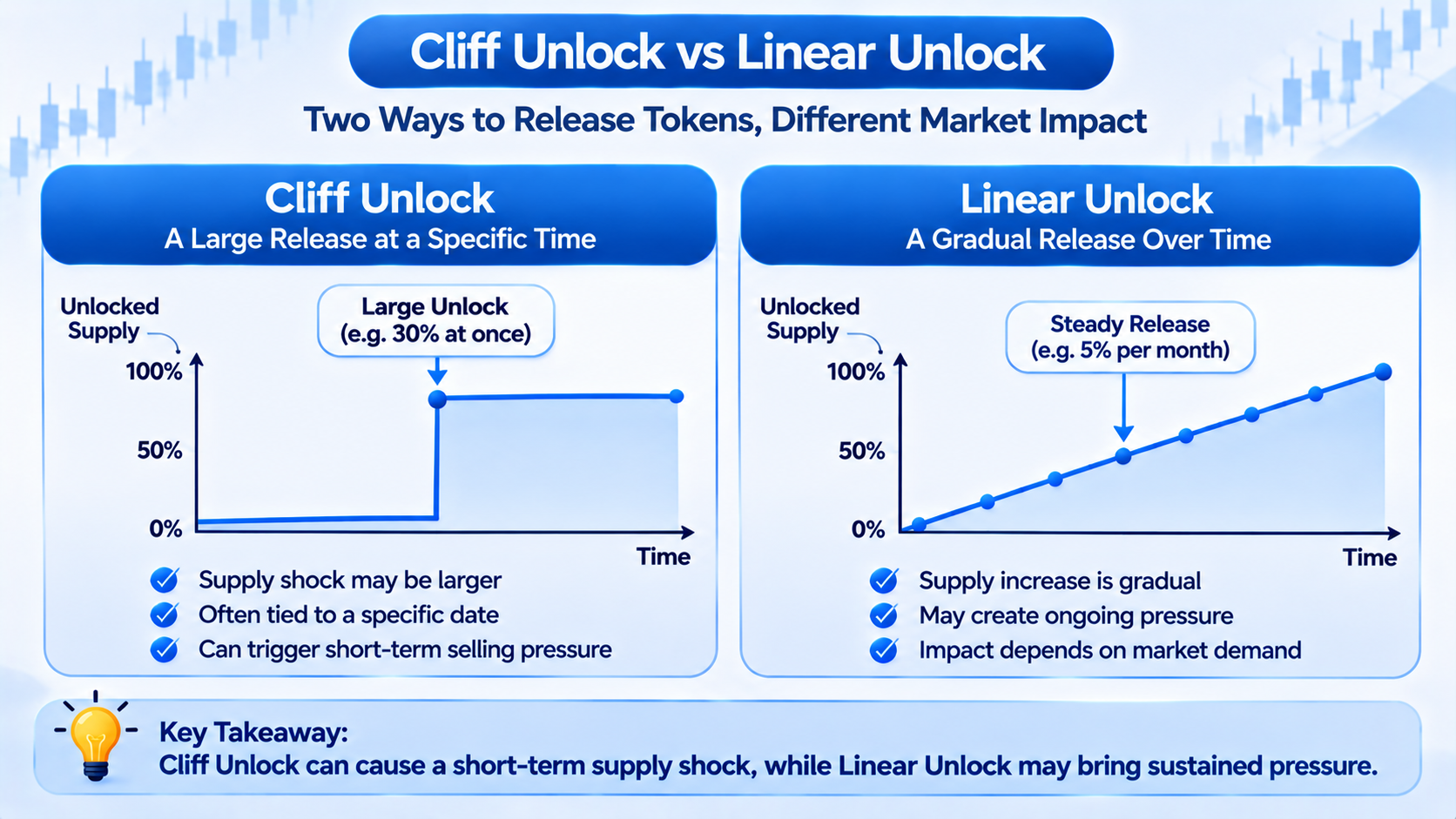
Token unlocking mechanisms can generally be divided into two main categories: Cliff Unlock and Linear Unlock.
Cliff Unlock refers to tokens being released at a specific point in time after a predetermined lock-up period. A cliff period may also precede linear vesting, allowing holders to receive their first allocation only after meeting a minimum service or holding requirement.
For example, suppose a project allocates 10 million tokens to early investors and specifies that 3 million tokens will unlock simultaneously six months after launch. This arrangement could create a noticeable change in potentially circulating supply on a particular date.
Linear Unlock, by contrast, gradually releases tokens according to a predetermined schedule. For example, if a project plans to release 10 million tokens over 20 months using equal monthly installments, 500,000 tokens would become unlocked each month.
The primary difference between these two mechanisms lies in how token releases are distributed over time.
\[Table unavailable outside Lark\]
Importantly, Cliff Unlock is not necessarily riskier than Linear Unlock. Although cliff unlocks may create substantial one-time supply changes, market participants can often anticipate the release date and adjust their price expectations in advance.
Conversely, while linear unlocking spreads token releases over time, it may still create persistent selling pressure if new demand fails to grow sufficiently.
Some projects also adopt hybrid structures. For example, tokens may remain locked for one year, after which 25% are released immediately and the remaining allocation unlocks linearly each month. Such arrangements require investors to assess both the initial concentrated release and the subsequent rate of continuous supply expansion.
Therefore, evaluating token unlock risks requires more than identifying the type of mechanism. Investors must also examine the actual release amount, schedule, and prevailing market liquidity.
## Why Can Token Unlock Events Create Selling Pressure?
Token unlock events attract investor attention primarily because they may change the amount of tokens available for sale in the market. Once previously restricted tokens become transferable, holders can choose to sell them, continue holding them, or participate in other on-chain activities.
If the amount of newly available supply is substantial and market buying demand does not increase accordingly, the balance between supply and demand may change. In markets with limited liquidity, even a portion of unlocked tokens entering trading platforms can significantly affect prices.
For example, suppose a token has a circulating supply of 100 million tokens and a market price of \$1. The project is scheduled to unlock another 20 million tokens. If these tokens were previously excluded from circulating supply and all qualify for inclusion after unlocking, circulating supply could increase to 120 million tokens, representing a 20% increase relative to the original circulating supply.
However, this does not mean the token price will necessarily decline by 20%. Token prices do not mechanically adjust in proportion to changes in circulating supply. Instead, they are determined by actual buy and sell orders, holder expectations, and market demand.
Selling pressure associated with token unlocks generally operates through three channels.
- Actual selling pressure: Some holders may transfer unlocked tokens to trading platforms and sell them to realize profits or meet funding needs.
- Anticipatory selling pressure: Because most unlock dates can be identified in advance, traders may adjust their positions before the event. For example, some investors may reduce their holdings or establish short positions through derivatives, causing price pressure to emerge before the actual unlock date.
- Changes in market liquidity: When investors broadly expect large token releases, potential buyers may delay purchases, while market makers may adjust their quotes to manage risk. Even when the actual amount sold remains uncertain, reduced buying demand can amplify price volatility.
Historical research provides some context for these mechanisms. An analysis of thousands of token unlock events by 6th Man Ventures found a negative correlation between larger unlock events and token price performance, while smaller unlock events did not exhibit the same degree of statistical significance.
However, such research does not establish that token unlocks are the sole cause of price movements.
Therefore, selling pressure associated with Token Unlock events may arise from actual asset sales or from the market pricing in anticipated supply changes before the release occurs.
## Why Is the Token Unlock Ratio More Important Than the Unlock Value?
When investors review token unlock calendars, they frequently encounter projects scheduled to release tokens worth tens or even hundreds of millions of dollars. However, the dollar value alone is insufficient to determine the level of risk.
Different projects vary considerably in circulating supply and market capitalization.
Suppose Project A is about to unlock \$50 million worth of tokens, while its existing circulating market capitalization is \$5 billion. Project B is scheduled to unlock \$20 million worth of tokens, but its circulating market capitalization is only \$100 million.
Although Project A has a larger unlock value, Project B may experience a much greater relative increase in available supply. Assuming other conditions remain equal, Project B faces a more significant proportional supply change.
Therefore, investors should first examine the ratio of unlocked tokens to the existing circulating supply. This indicator helps explain how large the newly unlocked allocation is relative to the current market supply.
However, it does not directly represent the proportion of tokens that will actually be sold, since some holders may continue holding their allocations.
Another important consideration is the difference between a token's Fully Diluted Valuation (FDV) and circulating market capitalization.
For projects with low circulating supply ratios and substantial amounts of tokens awaiting release, current market prices may be determined by a relatively small portion of the total token supply. As additional tokens gradually enter circulation, the market must absorb the new supply to maintain existing prices, assuming other conditions remain unchanged.
However, a high FDV does not necessarily mean a token is overvalued. Valuation assessments must also consider project revenue, token utility, holder demand, future release schedules, and broader market conditions.
Investors should also compare unlock size with spot trading volume.
For example, suppose a token is scheduled to unlock \$30 million worth of assets, while its average daily genuine spot trading volume is only \$5 million. Even if only a portion of the unlocked tokens is sold, the resulting transactions could significantly affect the market.
However, trading volume is not equivalent to order book depth. High daily trading volume may result from repeated high-frequency transactions and does not guarantee that the market can absorb an equally large sell order within a short period.
A more comprehensive assessment should therefore consider the unlock ratio, circulating market capitalization, genuine trading volume, and order book depth together.
## How Do Team, Early Investor, and Ecosystem Fund Unlocks Differ?
Different categories of token holders may have different acquisition costs, funding requirements, and investment objectives. As a result, unlock events of similar sizes do not necessarily produce the same market impact.
Early investors typically acquire tokens through seed rounds, private placements, or other financing arrangements. Their acquisition costs may differ substantially from public market prices.
If the token's market price is significantly higher than their original investment cost, some early investors may choose to realize profits after unlocking.
However, this does not mean early investors will necessarily sell. Some institutions may be subject to internal investment strategies, fund lifecycles, over-the-counter agreements, or long-term allocation plans. Their actual selling activity may occur at a different time from the unlock date.
Team tokens are generally intended to incentivize developers, management personnel, and core contributors. Team unlock schedules may be linked to long-term service commitments, giving them a different economic purpose from early-stage financing allocations.
For team members, unlocked tokens may be used for compensation, tax obligations, or personal asset allocation. They may also continue holding their tokens.
If team members consistently sell substantial amounts over an extended period, investors may question whether their financial interests remain aligned with the project's long-term development.
Ecosystem funds and community incentive tokens serve different purposes.
These tokens may be distributed to developers, liquidity providers, ecosystem partners, or participants in incentive programs. Some allocations may support project development rather than immediately entering the secondary market.
For example, an ecosystem fund unlocking 10 million tokens does not mean all 10 million tokens will be transferred to exchanges on the unlock date. The project may distribute the tokens gradually according to grant schedules or reserve a portion for future ecosystem activities.
However, if ecosystem incentives are continuously distributed in token form and recipients have limited incentives to hold them long term, these tokens may gradually translate into market selling pressure.
Therefore, investors should not assess unlock risks solely based on whether the recipients are teams, investors, or ecosystem funds. They should also examine acquisition costs, actual distribution arrangements, and on-chain transfer behavior.
## Why Do Some Tokens Decline Before Unlocking but Rise Afterward?
Token unlock events are generally known in advance, allowing markets to begin reflecting expectations before the actual release.
When traders anticipate that a large unlock will increase available supply, they may sell spot holdings or establish short positions through perpetual futures contracts.
These actions can cause token prices to decline several days or even longer before the scheduled unlock.
If the actual amount sold after unlocking is lower than market expectations, traders who previously established short positions may close those positions, creating additional buying demand.
Under such circumstances, token prices may rebound after unlocking even though circulating supply has increased.
Another possibility is that unlock expectations have already been priced in.
Market participants may have completed their position adjustments before the release, leaving little additional concentrated selling pressure on the actual unlock date.
Token prices may also be influenced by improving project fundamentals, a broader market rally, or significant ecosystem developments.
If new demand exceeds the amount of unlocked tokens actually sold, prices may continue rising.
A 2025 study of token unlock events found that the price impact of larger unlocks may occur both before and after the scheduled release rather than being concentrated entirely on the unlock date.
This suggests that both market expectations and actual supply changes can contribute to price formation.
However, this does not mean tokens will inevitably decline before unlocking and rebound afterward.
If holders continue selling after the unlock or market demand weakens further, prices may continue declining.
For projects with linear unlocking schedules, additional supply may enter the market over an extended period, meaning there may be no single date when the associated risks disappear.
Therefore, post-unlock price performance depends on the relationship between actual selling activity and new demand, rather than simply whether the unlock event has been completed.
## How Can On-Chain Data Reveal Whether Unlocked Tokens Are Being Sold?
Token unlock calendars help investors understand future supply schedules, but they cannot directly answer a critical question: Where do the tokens go after they are unlocked?
To assess whether potential selling pressure is translating into actual sales, investors can use blockchain explorers and on-chain analytics tools to track fund movements associated with unlocked allocations.
The first step is to identify token vesting contracts and recipient addresses.
Some projects manage token releases through publicly accessible vesting smart contracts. Investors can examine release rules, claimable amounts, and associated token transfer records.
If the project publicly discloses addresses associated with teams, investors, or ecosystem funds, investors can also monitor changes in those addresses' balances.
Another important indicator is whether unlocked tokens are transferred to trading platforms.
When substantial amounts move from vesting contracts or identified recipient addresses to exchange deposit addresses, holders may be preparing to trade.
However, an exchange deposit does not necessarily indicate that the tokens have already been sold. Such transfers may also involve custody arrangements, market-making activities, internal transfers, or other operational requirements.
Investors can also examine changes in recipient wallet balances.
If unlocked tokens remain in recipient addresses for an extended period, it indicates that the tokens have not been transferred on-chain from those addresses.
However, this does not conclusively prove that holders have not entered into over-the-counter transactions or transferred other economic rights.
If tokens are repeatedly distributed across multiple addresses, further analysis is needed to determine the relationships between those addresses and avoid misinterpreting routine asset management as concentrated selling.
Some tokens may also be sold through decentralized exchanges (DEXs).
In these cases, investors can monitor liquidity pool reserves, transaction sizes, and price slippage to assess whether significant selling activity has occurred.
It is important to recognize that on-chain data does not capture every transaction.
Trades executed within centralized exchanges are generally not recorded individually on the blockchain. Therefore, blockchain transfers alone cannot accurately determine the total number of tokens sold.
For retail investors, on-chain fund flows are better understood as risk-monitoring indicators rather than direct trading signals.
## How Can Market Liquidity Help Assess Token Unlock Price Risks?
Market liquidity is a major factor determining whether newly unlocked tokens can be absorbed without substantial price disruption.
Even when two projects have identical unlock ratios, their actual price impact may differ considerably because of differences in trading depth and market participant structure.
In highly liquid markets, larger sell orders can be absorbed by more buyers, potentially limiting price impact.
In less liquid markets, even a relatively small portion of unlocked tokens entering the market may quickly consume available buy orders, resulting in significant slippage.
For example, suppose a token is scheduled to unlock 10 million tokens, but only 1 million are ultimately sold.
If exchanges have sufficient buying demand, this additional supply may be absorbed gradually.
However, if the token has shallow order book depth and market participants broadly expect prices to decline, buyers may lower their bids.
Sellers may then need to accept lower prices to complete their transactions.
Under these conditions, prices may experience substantial pressure even though the actual amount sold is far smaller than the total unlock allocation.
Therefore, liquidity assessments should focus on spot order book depth, bid-ask spreads, genuine trading volume, and expected slippage for large orders.
For tokens that also have perpetual futures markets, investors can examine Open Interest (OI), funding rates, and liquidation distributions.
If substantial short positions have accumulated before an unlock event, weaker-than-expected selling pressure may trigger short covering.
Conversely, if the market contains a large concentration of highly leveraged long positions, falling prices may trigger cascading liquidations and amplify volatility.
However, derivatives data reflects market positioning and trading sentiment. It does not directly prove that unlocked tokens have been sold in the spot market.
Token unlock risk assessments should therefore combine supply changes with liquidity conditions rather than relying solely on unlock quantities to predict price movements.
## How Can Investors Build a Token Unlock Risk Assessment Framework?
For retail investors, token unlock analysis can be organized around four dimensions: supply size, holder structure, fund flows, and market absorption capacity.
\[Table unavailable outside Lark\]
In practice, investors can begin by identifying token release schedules over the next 30 or 90 days and calculating the unlocked amount as a percentage of current circulating supply.
It is also important to distinguish between recipient categories.
If most tokens are allocated to teams and early investors, investors should examine acquisition costs, lock-up arrangements, and historical fund transfers.
If the majority of tokens are allocated to ecosystem funds, the analysis should focus on whether the funds have clearly defined purposes and actual distribution plans.
Investors can then compare the unlock amount with prevailing market liquidity.
If the potential selling volume is substantial and order book depth is limited, the market may be more sensitive to additional sell orders.
Fund movements before and after the unlock should also be monitored.
When unlocked tokens begin moving and corresponding trading activity or liquidity changes emerge, investors can more specifically assess whether potential selling pressure is becoming actual market pressure.
However, this framework can only help identify risks. It cannot guarantee accurate predictions of price direction.
Token prices are also influenced by macroeconomic conditions, market sentiment, project developments, and broader cryptocurrency market trends.
Therefore, investors should not assume that a token's price will inevitably decline simply because an unlock event is approaching. Likewise, the completion of an unlock event does not mean all associated risks have disappeared.
## Conclusion
Token unlocking is an important component of cryptocurrency tokenomics. Its primary function is to gradually release tokens previously subject to lock-up periods or vesting restrictions according to predetermined rules.
By establishing appropriate release schedules, projects can align the long-term interests of teams, investors, and ecosystem participants. However, token unlocks may also change the amount of supply available for sale in the market.
Token Unlock events may create selling pressure because some holders choose to sell after gaining control of their tokens, either to realize profits or meet funding requirements.
When additional supply exceeds the market's buying capacity, prices may come under pressure. However, unlocking is not equivalent to selling, and price movements do not follow a fixed proportion relative to unlock quantities.
Assessing token unlock risks requires examining Cliff Unlock and Linear Unlock mechanisms, the ratio of unlocked tokens to circulating supply, holder composition, exchange fund flows, and spot market liquidity.
For projects with low circulating supply ratios, substantial future token releases, or limited market depth, ongoing supply changes deserve particular attention.
Furthermore, because unlock schedules are generally known in advance, markets may price in the expected supply changes before the official release date.
After unlocking, prices may continue declining or rebound if actual selling pressure is lower than expected or short covering generates additional demand.
Ultimately, understanding how token unlocks affect prices requires more than identifying how many tokens are scheduled for release. The key is to assess whether those tokens are likely to be sold and whether existing market demand can absorb the additional supply.
## FAQ
### What Does Token Unlock Mean?
Token Unlock refers to the process by which tokens previously restricted by lock-up periods or vesting schedules become transferable, tradable, or usable after specific conditions are met. It is an important component of token distribution mechanisms in cryptocurrency projects.
### Does Token Unlock Always Cause Token Prices to Fall?
Not necessarily. Token unlocking increases the potential supply available for sale rather than the actual number of tokens sold. If holders continue holding their tokens or market buying demand is sufficient to absorb additional supply, prices may not decline.
### Which Is Riskier, Cliff Unlock or Linear Unlock?
The risks depend on release size, holder behavior, and market liquidity. Cliff Unlock may create a concentrated supply shock, while Linear Unlock may generate sustained supply pressure over time.
### How Is the Token Unlock Ratio Calculated?
The unlock ratio is typically calculated by comparing the number of tokens scheduled for release with the circulating supply before the unlock.
For example, if a token has an existing circulating supply of 100 million tokens and another 10 million tokens are unlocked, the unlock amount represents 10% of the original circulating supply.
Author: Learn Team
* The information is not intended to be and does not constitute financial advice or any other recommendation of any sort offered or endorsed by Gate Web3.
* This article may not be reproduced, transmitted or copied without referencing Gate Web3. Contravention is an infringement of Copyright Act and may be subject to legal action.
Related Articles

Beginner
Will Sidra Break $1,000? A Realistic Look at Sidra Chain Price Claims in 2026–2027
Sidra Chain positions itself as a Shariah-compliant blockchain for users who want crypto activity without interest (riba), excessive uncertainty (gharar), or non-halal assets. That narrative explains why the project still has a large community around mining, KYC, SidraStart, and a future SDA listing. It does not, by itself, create a public market price.

Beginner
BlockDAG (BDAG): A High-Speed and Secure Layer 1 for the Next Era
BlockDAG leverages a parallel PoW and DAG architecture to break through the bottlenecks of conventional single-chain designs, delivering high throughput at 10 BPS (with a target of 100+ BPS) and second-level transaction confirmation—all while preserving the Bitcoin-grade security provided by PoW.

Beginner
Rising Prices but Bearish Funding Rates: Is Crypto Entering a “Layered Bull Market” After Wall Street Capital Inflows?
In mid-April, the crypto marketplace saw a unique scenario where a price rebound coincided with a bearish funding rate. This article dissects the new structure behind the capital mismatch between spot and futures by analyzing Goldman Sachs' application for the Bitcoin Premium Income ETF, shifts in ETF capital flows, the renewed activity of ETH, and Coinglass fee rate data. It further provides an actionable three-indicator observation framework and corresponding risk management approaches.
Beginner
What is USDC? A Complete Guide to One of the Most Trusted Stablecoins
USDC is a stablecoin pegged 1:1 to the U.S. dollar, jointly launched by Circle and Coinbase, and governed by the Centre Consortium.

Beginner
Fractional NFTs: Lowering Barriers and Enhancing Liquidity
Fractional NFTs divide unique, indivisible NFTs into tradable shares, allowing a broader range of investors to access high-value digital asset trades and significantly enhancing liquidity within the NFT marketplace.

Beginner
USDD vs USDT: A Comparison of Stablecoin Mechanisms, Risks, and Use Cases
The core differences between USDD and USDT lie in their issuance models, stabilization mechanisms, and risk structures. USDD is an overcollateralized stablecoin with higher yield potential, while USDT is issued by a centralized entity and backed by fiat reserves, relying on redemption mechanisms and market trust to maintain its peg. USDT offers stronger liquidity but comes with regulatory and custodial risks. Each serves different user needs: USDT is better suited for trading and hedging, while USDD is designed for DeFi yields and on-chain applications.