2025 Solana Staking Complete Guide: How to Safely Stake SOL with Phantom Wallet and Earn Rewards
Solana (SOL) Price and Market Trends
Currently, Solana (SOL) trades at around $136–137 per token, with limited 24-hour volatility. Its market capitalization continues to lead most Layer-1 blockchains. After reaching its all-time high in early 2025, Solana entered a correction phase. Despite this, mainnet activity and ecosystem growth remain robust, especially in the DeFi, NFT, and staking sectors, which are steadily expanding.
Phantom Wallet recently launched real-time rewards tracking and one-click staking features, significantly improving the staking experience.
What Is SOL Staking?
Solana operates on a Proof-of-Stake (PoS) protocol. SOL holders can participate in network consensus by staking their tokens, earning rewards in the process. In essence, staking involves delegating your SOL to a validator node, contributing to transaction processing and network security. You receive staking rewards proportional to your staked amount.
Benefits of Staking SOL with Phantom Wallet
Phantom Wallet stands out as one of the most popular non-custodial wallets in the Solana ecosystem. Key benefits include:
- Native staking interface;
- Support for liquid staking with PSOL, enabling ongoing DeFi participation;
- Native staking preserves complete control over your SOL;
- Newly added real-time rewards tracking improves transparency.
Native Staking vs. Liquid Staking (PSOL): What’s the Difference?
Phantom Wallet offers two primary staking options for SOL:
Native Staking
- SOL is delegated to a validator;
- Funds are locked and not transferable during the staking period;
- Rewards are paid directly in SOL;
- Closely follows traditional PoS architecture.
Liquid Staking (PSOL)
- Staking yields PSOL tokens, which can be used in DeFi applications;
- PSOL represents your staked share, and its value appreciates over time;
- Enables more flexible strategy combinations.
For users seeking liquidity, PSOL offers a compelling alternative.
Phantom Wallet Staking: Step-by-Step Guide
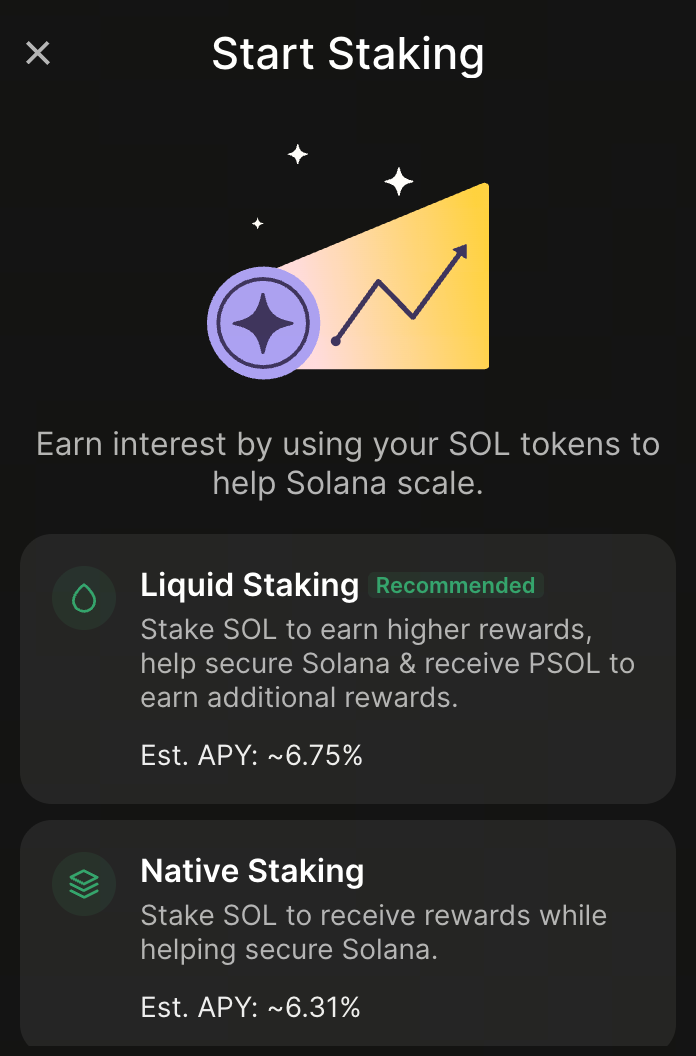
Whether you choose native staking or liquid staking, the process is generally as follows:
Native Staking Instructions:
- Open Phantom Wallet and select your SOL assets;
- Click “More → Stake SOL”;
- Select “Native Staking”;
- Pick a reputable validator and enter your staking amount;
- Confirm and submit the transaction;
- Wait for staking activation (usually 2–3 days).
Liquid Staking (PSOL) Instructions:
- Navigate to “Start Earning”;
- Enter the amount of SOL you wish to stake;
- Confirm to receive PSOL tokens;
- Configure PSOL for additional yield in DeFi protocols.
How to Claim Staking Rewards and Risk Considerations
Staking rewards are distributed per Solana network epoch, each lasting approximately 2–3 days. Native staking rewards accrue directly in your account, while PSOL rewards are reflected in the token’s price appreciation.
Risk Considerations:
- Price volatility: SOL remains subject to market fluctuations;
- Validator risk: Selecting unstable or high-fee validators may reduce returns;
- Liquidity risk: PSOL can face liquidity challenges within DeFi protocols.
Summary and Long-Term Strategy Recommendations
Staking Solana is no longer just about earning yield—it’s a vital way to participate in the ecosystem. With Phantom Wallet, you can flexibly switch between native staking and PSOL strategies. As the ecosystem continues to grow, staking tools improve, and real-time reward tracking becomes standard, 2025 remains a prime opportunity for Solana staking.
Related Articles

The New Era of the NFT Market: From Explosive Peaks to Rational Transformation

The Next 100x Coin? Low-Cap Crypto Gem Analysis

Best Crypto Wallets to Watch in 2025: Top Picks for Security and Convenience

MathWallet Quick Start Guide

Zora NFT Market Update: ZORA Token Airdrop, Layer-2 Expansion, and Creator Incentive Mechanisms