Best Metaverse Projects in 2025: Seizing the Next Digital Wave
1. Metaverse Development Status and Core Trends for 2025
After the explosive growth in 2021 and subsequent market corrections, the Metaverse is entering a new phase in 2025 that prioritizes utility and technological advancement. This stage is defined not just by virtual land transactions but by several key trends:
- AI Integration: Generative AI is being embedded into virtual worlds, enabling smarter NPCs, more dynamic environments, and streamlined content creation tools.
- Cross-Platform Interoperability: The ability to transfer virtual assets and identities freely across different metaverse platforms is becoming a major industry focus.
- Industrial Applications (Digital Twins): The Metaverse is fueling substantial B2B market growth through enterprise collaboration, simulation, and digital twin technology.
- XR Device Adoption: The rollout of next-generation extended reality (XR) devices, such as Apple Vision Pro, is dramatically enhancing user immersion and accessibility.
In this context, we have curated 2025’s most promising “Top Metaverse Projects,” which represent the future direction of the digital landscape.
2. Web3 Blockchain Metaverse: Building the Decentralized World
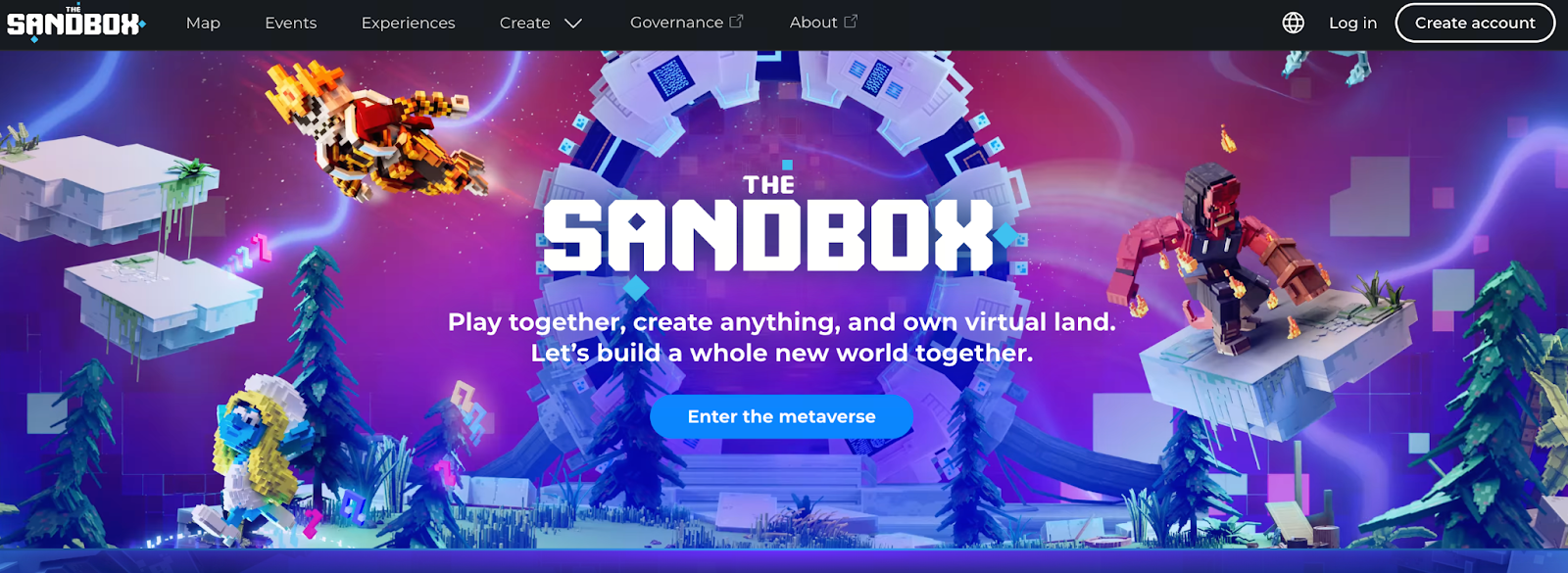
Source: https://www.sandbox.game/en/
The decentralized metaverse is distinguished by true digital asset ownership (via NFTs) and community governance (via DAOs), creating a user-driven virtual economy.
2.1 The Sandbox (SAND): A Hub for Content Creators
- Latest Developments: The Sandbox is expanding its partnerships with global IPs and brands, including a major collaboration with Saudi Arabia’s Digital Government Authority, highlighting its reach beyond the Web3 sector. The platform continues to roll out more $SAND staking rewards and Game Maker features to foster new user-created gaming experiences.
- Price and Market Cap: As a leading blockchain gaming metaverse, $SAND remains volatile. However, its vast partner ecosystem and strong UGC community have helped it maintain a top market cap among metaverse tokens.
- Core Value: Advanced user-generated content (UGC) tools and a robust Play-to-Earn (P2E) model.
2.2 Decentraland (MANA): Virtual Real Estate Pioneer
- Latest Developments: Decentraland is focused on improving its flagship virtual world, Genesis City, with avatar upgrades, a new desktop client, and enhanced social features. Signature events like Metaverse Fashion Week and music festivals continue to draw attention from the Web3 community.
- Price and Market Cap: $MANA was one of the earliest metaverse tokens, with its price closely linked to virtual land (LAND) trading activity. Although the market has cooled, community governance and the scarcity of virtual real estate continue to provide a solid foundation for its value.
- Core Value: Community-led governance and a mature virtual property economy.
3. Web2 Giants and Industrial-Scale Metaverse Strategies
Web2 giants bring massive user bases and deep technological expertise, especially in virtual reality hardware and enterprise applications.
3.1 Meta Horizon Worlds: The King of Social Experiences
- Latest Developments: With the widespread adoption of Meta Quest headsets, Meta Horizon Worlds continues to refine its social features and creator tools. While its monetization strategies are still evolving, its user base and VR hardware ecosystem remain unmatched.
- Core Value: The largest VR-first social metaverse ecosystem, backed by Meta’s significant financial and technological resources.
3.2 Roblox: UGC Platform Benchmark
- Latest Developments: Roblox is upgrading to serve a more mature user base and deliver increasingly realistic graphics. Immersive experiences on the platform have become key venues for brand marketing and education.
- Core Value: A leading UGC platform for younger audiences, featuring a mature internal economy ($Robux).
3.3 Nvidia Omniverse: Industrial Digital Twin Infrastructure
- Latest Developments: Nvidia Omniverse is now the go-to platform for enterprises building digital twins and industrial-grade 3D simulations. Its powerful GPU rendering and Universal Scene Description (USD) framework provide essential infrastructure for manufacturing, construction, and more.
- Core Value: State-of-the-art industrial metaverse infrastructure focused on enterprise collaboration and simulation.
4. Key Technological Innovations for Metaverse Projects in 2025
Looking ahead to 2025, the success of metaverse projects will hinge on several technological breakthroughs:
- AI-Powered Asset Creation: Instantly generate 3D assets from simple text prompts or sketches, dramatically lowering the barrier to content creation.
- Web4 Infrastructure: Designed to seamlessly integrate the metaverse, AI, and blockchain, driving greater decentralization and intelligence.
- Spatial Computing: Devices like Apple Vision Pro are enabling high-precision, low-latency mixed reality experiences, accelerating the convergence of the metaverse with the physical world.
5. Conclusion: How to Capture Metaverse Investment Opportunities
The 2025 metaverse market is diverse and driven by technology. For investors and users, the keys to capitalizing on opportunities include:
- Diversification: Pay attention to platform tokens in the Web3 space such as $MANA and $SAND, as well as infrastructure and high-quality gaming projects like $ILV and $RNDR (Render).
- Application Focus: Assess whether projects have genuine user engagement and commercial viability, not just technical concepts.
- Technical Foresight: Track developments in AI, XR hardware, and cross-platform protocols—these will be critical for long-term project value.
The future of the metaverse spans both Web2 and Web3. Projects that combine decentralized ownership with exceptional user experiences are poised to ride the next wave of digital innovation.
Related Articles

The New Era of the NFT Market: From Explosive Peaks to Rational Transformation

The Next 100x Coin? Low-Cap Crypto Gem Analysis

Best Crypto Wallets to Watch in 2025: Top Picks for Security and Convenience

MathWallet Quick Start Guide

Zora NFT Market Update: ZORA Token Airdrop, Layer-2 Expansion, and Creator Incentive Mechanisms