Hamster Kombat Latest Update: HMSTR Linking, Airdrop, and Future Outlook Explained
What Are Hamster Kombat and HMSTR
Image: https://x.com/hamster_kombat
Hamster Kombat is a Web3 click-to-earn (P2E) mini-game built on the Telegram platform. Players can earn in-game currency by tapping, completing mini-games, inviting friends, and watching ads. The project team has promised to convert this in-game currency into real blockchain tokens through a future airdrop. The related token is HMSTR.
The project’s main appeal is the promise to “become the CEO of a crypto exchange,” blending gaming with crypto economics and drawing significant attention from users and players. With its low barrier to entry and simple gameplay, Hamster Kombat exemplifies the “game + token + community” model common in the Web3 ecosystem.
Project Metrics and User Base Trends
After its initial launch on March 26, 2024, Hamster Kombat quickly went viral. The project team claimed its global user base once surpassed 300 million.
However, the momentum did not last. By early 2025, active user numbers had dropped dramatically. Reports indicate that by February 2025, monthly active users had declined to roughly 11.5 million, and by April, the number fell further to about 7.67 million.
This steep decline in users signals a shift from explosive growth to stagnation for the project.
HMSTR Tokenomics and Airdrop Distribution
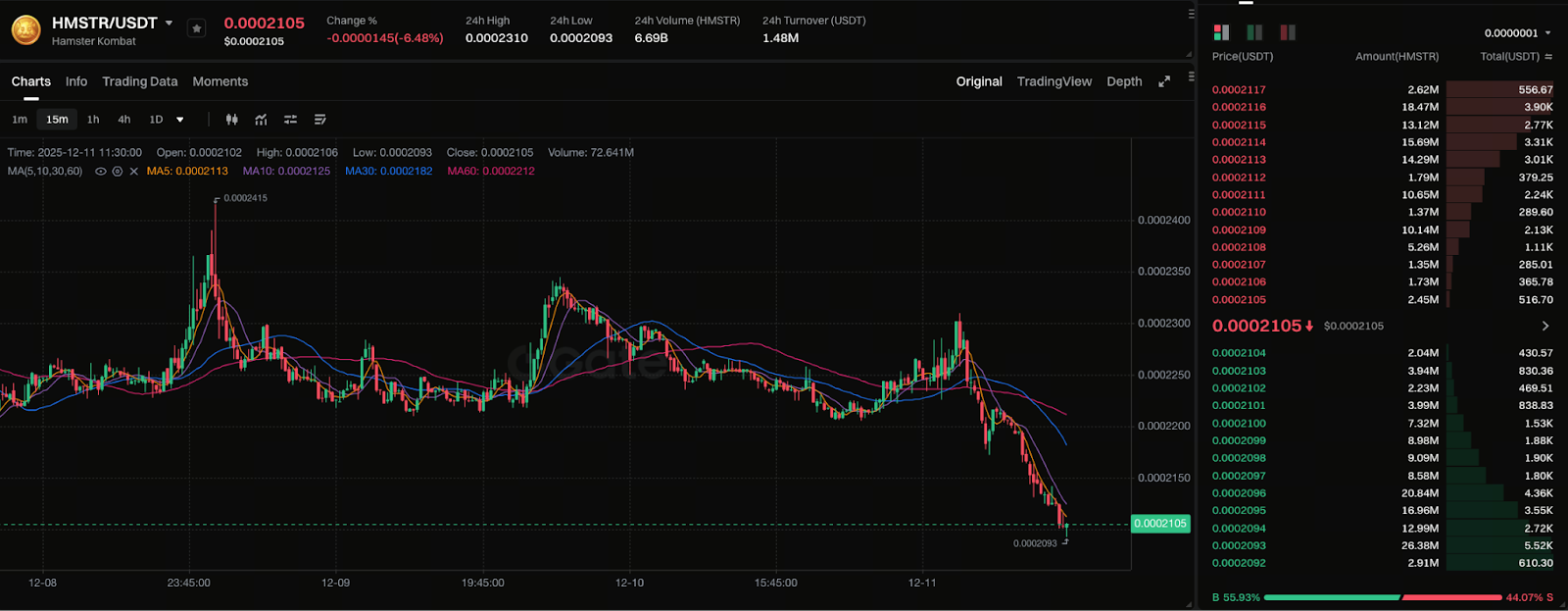
Image: https://www.gate.com/trade/HMSTR_USDT
HMSTR has a total supply of 100 billion tokens. Approximately 75% of the supply is allocated for airdrops, with another 3% used for liquidity mining during the Launchpool phase.
In September 2024, the project launched a Launchpool event, allowing users to participate with crypto assets like BNB and FDUSD to earn HMSTR rewards.
The team also announced plans to continue repurchasing tokens through ad network revenue in 2025 and to distribute tokens to players periodically—a mechanism similar to “token buyback and rewards.” They also intend to conduct token burns to reduce supply and increase scarcity.
Despite these measures, many players have voiced dissatisfaction with the airdrop and vesting mechanisms. Reports indicate that in the initial airdrop, only a portion of players received their full allocation, while about 11.25% of the tokens were locked and will vest gradually over the next 10 months.
Many users complained that, with an average of only about 600 tokens per person, the returns fell far short of the “get rich quick” expectations among early adopters.
Latest Technical Developments: Layer-2 Network and Ecosystem Expansion
Faced with user attrition and weak token prices, the Hamster Kombat team responded with new initiatives. In 2025, they launched a Layer-2 network based on the TON Network to boost transaction performance and scalability, laying the groundwork for additional games and features.
They also released an SDK, enabling third-party developers to create mini-games, DeFi features, and even NFT marketplaces within the Hamster Kombat ecosystem. These efforts aim to evolve the project from a simple clicker game into a comprehensive “Web3 gaming + community + economic system” platform.
Recent updates include daily Combo, card puzzle mini-games, and other features designed to increase user engagement and retention.
Community Governance: DAO Launch and Its Impact
To rebuild community trust and improve transparency, Hamster Kombat launched a Decentralized Autonomous Organization (DAO) at the end of 2024. Through the DAO, token holders and players can participate in project decision-making, promoting community-driven governance.
This move is intended to enhance the project’s long-term viability and strengthen the sense of involvement and belonging among players and holders. For a project that has experienced significant user loss and airdrop disputes, the DAO offers a chance to restore trust.
Risks and Controversies
Despite its initial popularity, Hamster Kombat has been the subject of numerous controversies and criticisms.
- Some users and media have accused the project of artificially inflating user and token numbers through bots and fake accounts in its early stages, with airdrops and rewards favoring insiders and early participants.
- Many players, even after consistently tapping and watching ads, earned only a limited number of tokens, falling short of the promised “easy money.”
- The token’s price performance has been disappointing. Public data shows that HMSTR remained weak after its listing, which left many players dissatisfied.
- Even with technical and ecosystem advancements, it remains highly uncertain whether the project can attract new users, maintain engagement, and build a truly sustainable economic system.
Summary
In summary, Hamster Kombat rapidly attracted hundreds of millions of users through its “low barrier + airdrop + cryptocurrency + viral community” strategy, making it a standout in the Web3 gaming sector. Its HMSTR token was distributed via Launchpool and airdrops, and the team has sought to expand the ecosystem with Layer-2, DAO, SDK, and other initiatives. This represents a comprehensive attempt at the “clicker game + crypto + community + economy” model.
However, the project still faces significant challenges, including large-scale user attrition, limited airdrop rewards, weak token price performance, and a lack of community trust. Hamster Kombat’s ambition to “link” its game, token, network, and community into a cohesive ecosystem will require sustained effort and time.
If you plan to follow or participate in Hamster Kombat, exercise caution, keep your expectations for returns in check, and closely monitor project updates and the transparency of community governance.
Related Articles

The New Era of the NFT Market: From Explosive Peaks to Rational Transformation

The Next 100x Coin? Low-Cap Crypto Gem Analysis

Best Crypto Wallets to Watch in 2025: Top Picks for Security and Convenience

MathWallet Quick Start Guide

Zora NFT Market Update: ZORA Token Airdrop, Layer-2 Expansion, and Creator Incentive Mechanisms