Tron Wallet Complete Guide: How to Choose, Use, and Harness TRX Potential
TRON and TRX: Core Concepts and Ecosystem Role
TRON is a decentralized blockchain platform built to provide infrastructure for decentralized applications (dApps), content distribution, stablecoin payments, and more. Its native cryptocurrency, TRX, powers network transaction fees, ecosystem governance, and access to various applications. TRON stands out for its fast transactions, low fees, and robust support for stablecoins (like USDT), as well as DeFi, NFTs, and content distribution.
Transferring funds, storing assets, participating in DeFi, or trading stablecoins on the TRON network requires an appropriate Tron Wallet.
Why a Tron Wallet Matters — Hot Wallet vs. Cold Wallet
In crypto, a wallet is a tool for managing private and public keys, overseeing assets, and executing transfers or signing transactions. For TRX, a wallet is critical for several reasons:
- Self-custody — Private keys and assets are directly managed, reducing reliance on exchanges and lowering risk exposure.
- On-chain transfers and interactions — Enables sending TRX, USDT-TRC20, participating in DeFi, staking, airdrops, and more.
- Flexibility — Hot wallets are ideal for frequent, small-value transactions and quick access; cold wallets are better suited for long-term, large-asset storage.
Hot wallets typically come as mobile apps or browser extensions for convenience and speed. Cold wallets, such as hardware or offline wallets, offer enhanced security for long-term storage.
Leading Tron Wallets and Feature Comparison
The TRON ecosystem and broader market offer several leading wallet options:
- Bitget Wallet — Supports TRON mainnet, TRX, and USDT wallet setup and import, on-chain transfers, asset management, swaps, staking, and more. It’s a comprehensive solution for managing TRON assets.
- Mobile and Hot Wallets (such as Trust Wallet or any TRON-compatible wallet) — Best for daily transfers and smaller transactions, offering high liquidity and ease of use.
- Cold Wallets / Hardware Wallets — Recommended for long-term or large-asset holdings, delivering higher security for users who transfer infrequently.
When selecting a wallet, ensure it supports the TRON mainnet (TRC-20 / TRC standards), USDT or other stablecoins, TRON network resource management (gas, energy, bandwidth), and provides access for staking or DeFi participation.
2025 TRX Price and Network Activity Snapshot
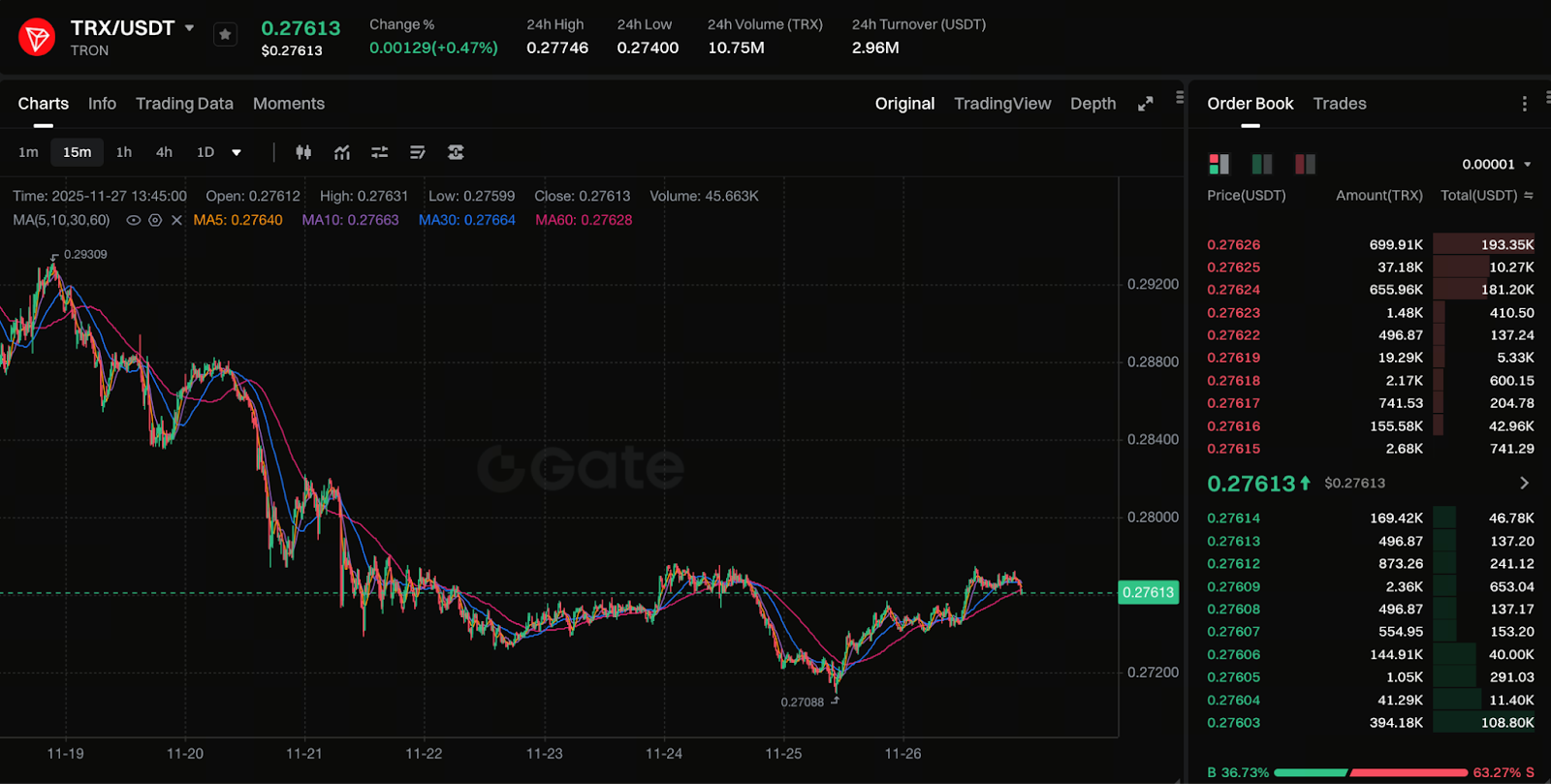
Chart: https://www.gate.com/trade/TRX_USDT
Recent data shows TRX trading in a range of approximately $0.27–$0.30. Despite this volatility, TRON network usage remains robust — TRON continues to lead in stablecoin (USDT) transfers and DeFi/ecosystem adoption.
Establishing a wallet at current price levels and averaging in may be a sound strategy, provided there is an understanding of the high volatility and inherent risks of crypto assets.
Key Considerations and Risk Management When Using a Tron Wallet
When managing assets with a Tron Wallet, consider the following:
- Private key security — The private key or recovery phrase is the foundation of asset security. Store it safely and never share it. For long-term holdings, use offline or cold storage.
- Network standard verification — Ensure tokens are sent or received on the TRON mainnet (TRC-20 / TRC standards) to avoid loss from network or address mismatches.
- TRON network resource management (gas, energy, bandwidth) — While TRON fees are low, network congestion or low balances can result in failed or costly transactions. Wallets providing automatic resource optimization can simplify management.
- Risk awareness and diversification — Crypto markets are highly volatile. Concentrating all assets in TRX is not recommended; consider dividing assets between long-term storage and liquid use.
- Secure backup and two-factor authentication — If available, enable 2FA and back up the seed phrase to protect against device loss or theft.
Conclusion: Who Should Use a Tron Wallet
For independent management of TRX, USDT, or other TRON-based tokens, participation in transfers, DeFi, stablecoin trading, staking, and other on-chain activities, or long-term asset holding and diversification, selecting an appropriate Tron Wallet is fundamental. New users might start with Bitget Wallet or a mobile hot wallet for ease of use. For medium- to long-term holders or those with significant assets, a cold wallet with robust security is recommended.
Note: Crypto assets are highly volatile and carry significant risk. Caution and sound risk management are essential.
Related Articles

The New Era of the NFT Market: From Explosive Peaks to Rational Transformation

The Next 100x Coin? Low-Cap Crypto Gem Analysis

MathWallet Quick Start Guide

Zora NFT Market Update: ZORA Token Airdrop, Layer-2 Expansion, and Creator Incentive Mechanisms

Ethereum Whales Revealed: Who Are the True ETH Giants in 2025?